
Airway clearance
How to Use a Cough Assist Machine at Home
A cough assist machine does the work of a cough for someone whose breathing muscles are too weak. It pushes a deep breath in, then switches fast to suction that pulls the air back out, dragging mucus up toward the mouth. Your job is positioning, a good mask seal, and watching the person instead of the screen. Every pressure, cycle count and session schedule belongs to the respiratory therapist.
Show guidance for someone who
Before you start
- The circuit and filter were washed after the last session and are completely dry
- The mask cushion is intact, with no cracks, splits or sticky residue
- Tissues, a towel and the suction unit if you have one are within arm’s reach
- They are not mid meal, and not lying flat
- You know which saved program your therapist told you to use, and you are not going to change it
The procedure
Confirm the program your therapist set
Power the machine on and check that the saved program on the screen is the one your team prescribed.
Hull University Teaching Hospitals NHS Trust tells families plainly that the program is set by the home ventilation team and should not be adjusted. Settings are titrated for one person’s lungs and do not carry across to anyone else.
Sit them upright with the head supported
Bring them to at least 45 degrees, sitting or well propped, and support the head so it does not fall forward or to the side.
A chin that drops onto the chest kinks the airway, so the machine works against a partly closed pipe. Neck weakness makes this happen quietly, without the person being able to tell you.
Fit the mask or mouthpiece
Settle the mask over the nose and mouth, or hand them the mouthpiece to hold between their lips, and check the edges sit flat against skin.
The machine can only reach the prescribed pressure if the seal holds. A leak at the bridge of the nose is the usual reason a session feels like it did nothing.
Start the prescribed program
Press start, or work the manual switch if that is how your team trained you, and let the machine run its full cycle.
Hold the seal through the whole cycle
Keep steady, even pressure on the mask from the breath in right through the pull out. If you have to lift it, lift it during a breath in or a pause, never during the pull out.
Breaking the seal on the exsufflation phase throws away the one part of the cycle that actually moves the mucus. That is the whole point of the treatment.
Watch their face, not the screen
Look at color, at whether the eyes are panicked, and at whether sputum has arrived in the mask.
Hull’s leaflet warns to stop if sputum collects in the mask, because the next breath in pushes it straight back down. A person who cannot speak through a mask has only their face to tell you with.
Pause between sets
Take the mask off at the end of a set, wipe the face, and give them time to breathe and to spit into a tissue before the next one.
Suction only what you can see in the mouth
If mucus has come up and they cannot spit it out, use the suction tip along the cheek and over the tongue, no further back than the back teeth, and no longer than ten seconds at a time.
Cambridge University Hospitals and Hull both set the back teeth as the limit, because going past them triggers the gag reflex, and warn never to chase a solid object, which suction only forces further down.
Wash the circuit before you put it away
Wash the circuit in mild liquid detergent and water after every session, then leave every part to dry completely before it goes back on the machine.
The Cough Assist T70 manual is specific that parts must be dry before reconnecting. A damp circuit stored warm is a place for bacteria to grow, on equipment whose entire job is preventing a chest infection.
Use caution
- The machine moves mucus up. It does not always get it out. Have tissues and, if your team supplied one, a suction unit within reach before you start.
- Do not use it on someone who is choking on food or an object. Hull’s leaflet warns this risks pushing the object further into the airway.
- Some lung histories make the pressure swings risky, including bullous emphysema, past barotrauma and previous collapsed lung. That is a conversation with the pulmonologist before the first session, not during one.
- Sessions are for before meals or well after them, not during. Sitting a person back down flat right after a treatment undoes the positioning work.
- Never change the pressures, the cycle count or the frequency yourself, even if a session feels like it is not working.
Stop and get help
- Breathing gets harder during the session rather than easier
- Lips, face or fingertips look dusky or gray
- There is blood in what comes up
- Mucus turns green, brown or foul smelling, or a fever starts, which can mean a chest infection
- The machine alarms, leaks or will not hold its pressure
- They are choking and cannot clear it, in which case this is a 911 call, not a treatment
Print the nine-step checklistOne page, large type, tape it to the wall by the bed.
Why a weak cough is the thing to watch
A cough is a deep breath in, a closed throat, and then a hard fast blast out. Weak breathing muscles take the blast away first. Secretions that used to clear without anyone noticing now sit in the lower airway, and a plugged airway can collapse the lung tissue behind it while stagnant mucus grows bacteria.
The Cough Assist T70 manual states the device exists to reduce the risk of retained mucus leading to a lung infection. That is the honest frame for all of this. You are not treating a disease. You are keeping a chest infection from starting.
Clinicians measure the cough rather than guess at it. Peak cough flow below 270 liters per minute is the usual trigger for offering mechanical insufflation-exsufflation in neuromuscular disease. A 2025 multicenter study in Scientific Reports found 93.9 percent of the ALS patients judged to need the device fell below that mark.
Ask your team what the measured number is. It is the clearest picture you will get of how much margin is left, and it turns a vague worry into something you can watch.
Thick mucus and thin drooling are different problems
These two get confused constantly, and the answers point in opposite directions. Thin saliva pooling in the mouth is not overproduction. As the ALS Guidance material puts it, the person makes a normal amount of saliva and simply cannot swallow it, move it around, or cough it out.
Thick, ropey mucus in the throat and chest is a separate problem with a separate answer. Drying agents aimed at drooling can make it worse, because what is left behind gets harder to shift, not easier.
| What you are seeing | What usually helps | Who decides |
|---|---|---|
| Thin saliva pooling, drooling at the corner of the mouth | Positioning, oral suction for comfort, and sometimes a drying medication | Medication for drooling is a doctor’s call, neurologist or primary care. Never a home experiment. |
| Thick, sticky mucus that will not come up | Hydration, humidification, and cough assist to move it toward the mouth | Respiratory therapist and pulmonologist set the device and the schedule |
| Both at once, on different days | Treat them separately, and say which one is happening when you call | Bring both patterns to clinic. Drying one worsens the other. |
The ALS Knowledge Base routes these two the same way we do: devices go to the respirologist or respiratory therapist, and any drug for saliva goes to the physician. That split matters because the two treatments actively fight each other. If you are managing swallowing and hydration as well, the nutrition and eating guidance covers the mealtime side of the same problem.
Suction and cough assist do different jobs
A suction machine reaches what is in the mouth. That is its whole range. Cambridge University Hospitals describes home oral suction as a comfort measure for oral secretion removal only. A cough assist machine reaches the lower airway, which is where the dangerous material sits.
The two are not alternatives, and owning one does not remove the need for the other. In practice you often run a session, then suction what the session brought up.
Cough assist devices are prescription equipment, supplied and set up through your team, so we do not link one here. A portable suction unit is different: it is a reasonable thing for a household to own outright, alongside whatever your team has issued rather than instead of it. Coverage for the prescribed side is covered on our equipment funding page.
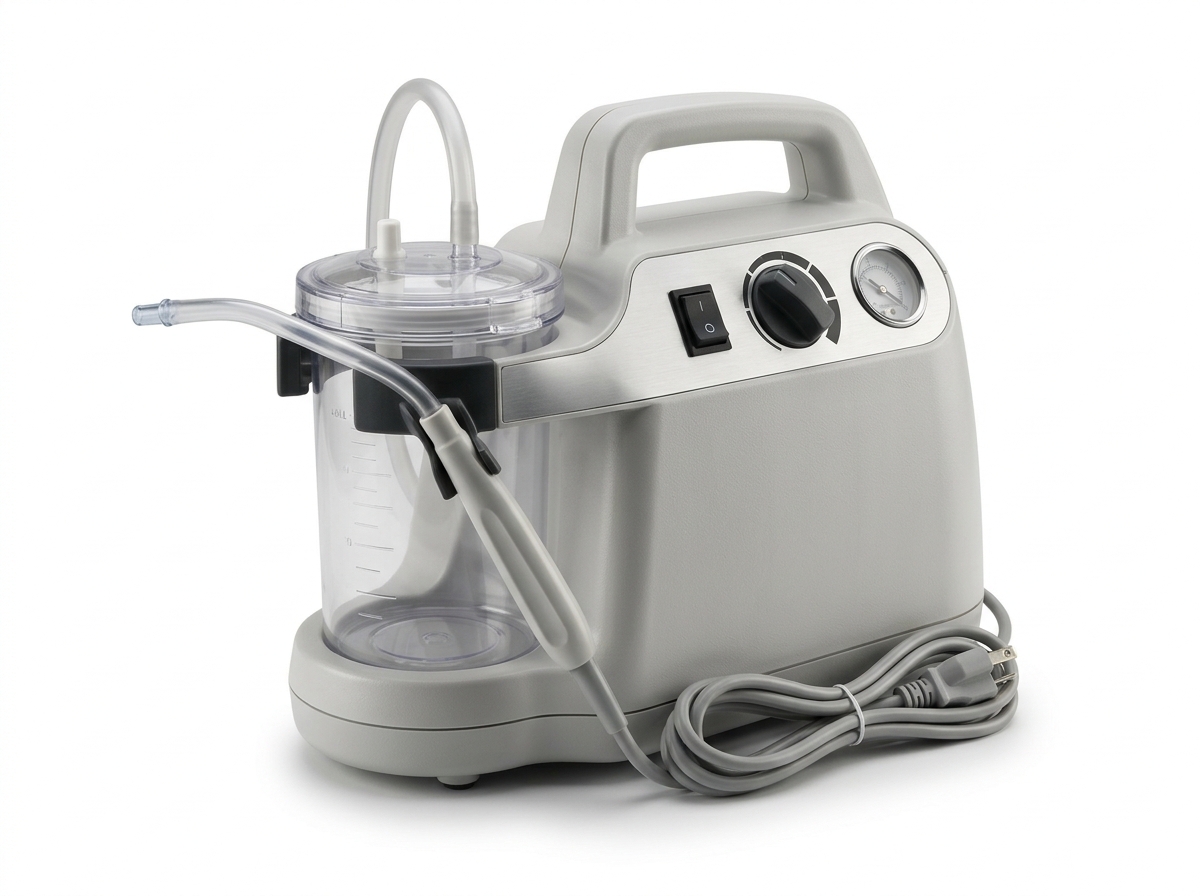
Oral secretions
Medline Vac-Assist Portable Suction Aspirator
A second unit, or a spare for the room where you do not keep the prescribed one, so nobody is carrying equipment down a hallway at 3am.
- Typical price band
- $60 to $130
- What it is for
- Secretions you can see in the mouth. Not the chest, and not a blockage you cannot see.
- Suction setting
- Comes from your respiratory therapist or nurse, not from us and not from the box.
- Consumables
- Yankauer tips and tubing get replaced when they discolor. Ask your supplier what your plan covers.
- Between uses
- Flush the tip with clean water before and after, wash daily, empty the canister as it fills, keep the battery charged.
Honest limitation: a suction unit cannot reach past the back teeth, and it must not be pushed there. It does nothing at all for secretions in the lower airway, which is the exact problem a cough assist machine exists to solve. Buying one is not a way to avoid needing the prescribed device.
We earn a commission on this link. It does not change the price you pay, and it does not influence which equipment we cover.
Cleaning and infection control between uses
This is the part that gets skipped when everyone is tired, and it is the part that decides whether the equipment prevents chest infections or delivers them.
Hull University Teaching Hospitals NHS Trust gives families four separate intervals: wipe the mask daily with a clean damp cloth to lift oil and saliva, hand wash it weekly in warm soapy water, change filters monthly and more often during an infection, and replace tubing quarterly.
Treat those intervals as an example rather than your rule. Your supplier and your own device manual set the schedule for your model, and consumable replacement is often tied to what your plan pays for.
Write the actual dates on a calendar by the machine. Nobody remembers when the filter was last changed, and the answer is almost always longer ago than it felt. More equipment sits in the respiratory and orthotic catalog.
When this stops working
Two things change over time. A mask seal gets harder to hold as facial and neck muscles weaken. That is a fit problem your team solves with a different interface, not something to push harder against.
Separately, if you are running more sessions and the chest still is not clearing, say so out loud at the next appointment. Both the frequency and the settings are theirs to revisit, and asking is not complaining.
Common questions
How often should we run a session?
Your respiratory therapist sets this and it varies widely. Hull’s patient leaflet describes a routine of every morning and evening with more during a chest infection, and a 2025 Scientific Reports cohort found most ALS users ran it daily, some once or twice and some three or four times. Those are descriptions of what other people do, not a schedule for you. Ask for yours in writing.
Can I use it while someone is choking?
No. Hull’s leaflet is explicit that the machine must not be used on someone who is choking, because the breath in can drive the object further down. Choking is an emergency, and the response is back blows, abdominal thrusts and 911, not a treatment session.
Do we still need a suction machine if we have a cough assist?
Usually yes. The cough assist moves secretions up toward the mouth but does not always get them out, and someone with a weak cough often cannot spit out what has arrived. Suction handles what you can see in the mouth. They cover different territory.
Can I change the pressure if a session does not seem to help?
No. Settings are titrated for one person, usually starting low and adjusted upward by a respiratory therapist, and a number that suits one set of lungs can be wrong for another. If sessions stop being effective, check the mask seal and the head position first, then call the team. Report it, do not fix it yourself.