
Breathing
Breathing Changes: What to Watch For and When to Call
Breathing muscles weaken quietly. Watch for breathlessness lying flat, a headache on waking, daytime sleepiness, a cough gone soft, and neck muscles working at rest. A slow change over weeks goes to the next appointment. Confusion, blue lips, or breathlessness at rest is a call today. You cannot see oxygen or carbon dioxide levels at home, and a fingertip device will not tell you.
Show guidance for someone who
Start here
- You cannot assess oxygen or carbon dioxide by looking. Neither can a fingertip clip.
- What you notice, and when it started, is real clinical information. Write it down with dates.
- Weak breathing muscles and a weak cough are the same problem, not two separate ones.
- Nothing here replaces what this person’s respiratory team has told you.
- If you are reading this because something changed tonight, go straight to the red block below.
Early signs of breathing problems a caregiver actually sees
Weak breathing muscles rarely announce themselves as breathlessness. They show up as tiredness, poor sleep, and a cough that has lost its punch. These are the signs clinical teams ask about, drawn from the respiratory and sleep literature on ALS and other neuromuscular conditions.
- Breathless lying flat. Called orthopnea. The 2019 review in Nature and Science of Sleep notes people compensate by propping themselves more upright in bed.
- A headache on waking that fades over the first hour or two. Both the Muscle Nerve 2023 pulmonary care review and the sleep literature list morning headache as a symptom of overnight carbon dioxide buildup.
- Daytime sleepiness. In a 2011 ALS capnography study, daytime drowsiness was present in about 81 percent of the patients assessed.
- Broken, unrefreshing sleep. Waking repeatedly, waking with a start, or never feeling rested no matter the hours.
- A weak cough. It sounds soft or wet, and it stops clearing anything.
- A quieter voice, shorter sentences. Running out of air partway through. StatPearls calls this conversational dyspnea.
- Neck and shoulder muscles working. The European Respiratory Review notes accessory muscle use and shallow breathing are typically late signs, not early ones.
Any one of these on its own can have another explanation. A cluster of them, or one that is clearly new this month, is worth a phone call rather than a wait.
Why breathing weakness shows up at night first
Sleep removes most of the backup. During REM sleep the body actively switches off skeletal muscle activity, and that includes the external intercostal and accessory breathing muscles. As the 2019 sleep review puts it, that atonia spares the diaphragm, so the diaphragm is left holding almost the whole job alone.
If the diaphragm is already weak, the same review states that alveolar ventilation becomes too low to sufficiently exhale carbon dioxide. Lying flat makes it harder again. That is why the earliest evidence of a problem is a night thing: unsettled sleep, then a morning headache, then a day spent exhausted.
The practical consequence matters. Someone can look and sound completely normal sitting in a chair at 2pm and still be under-breathing every night. Daytime observation alone will miss it, which is exactly why clinics order overnight testing.
What you notice, what it may mean, what to do
| What you notice | What it may mean | What to do |
|---|---|---|
| Needs more pillows, or has moved to a recliner to sleep | Orthopnea, the diaphragm struggling against gravity | Raise it at the next appointment. Sooner if it changed within a week. |
| Headache on waking that eases after an hour up | A recognized symptom of carbon dioxide building up overnight | Call the clinic. Ask whether overnight testing is due. |
| Falling asleep in conversations, in front of the TV, at meals | Sleep is being fragmented by shallow overnight breathing | Call the clinic. This is a reportable change, not just tiredness. |
| Waking repeatedly through the night, restless, unrefreshed | Sleep-disordered breathing | Count the wakings for three nights. Take the number to the visit. |
| Cough sounds soft or wet and clears nothing | Expiratory muscles too weak to generate cough flow | Ask for a peak cough flow measurement and an airway clearance plan. |
| Voice quieter, sentences getting shorter | Less air behind speech, or weakness in the mouth and throat | Mention it. Ask for speech-language pathology input to tell which. |
| Neck and shoulder muscles visibly working while sitting still | Accessory muscle recruitment, described in the literature as a late sign | Call the same day. Do not wait for the scheduled appointment. |
| Confusion, blue or gray lips, cannot finish a sentence | Possible acute respiratory failure | Emergency services now. See the red block below. |
A normal pulse oximeter reading is not reassurance
This is the single most important thing on this page. A fingertip pulse oximeter measures the saturation of oxygen carried in the red blood cells. It does not measure carbon dioxide. In weak breathing muscles, carbon dioxide is usually the thing going wrong first.
The 2011 PLoS One capnography study states it plainly: nocturnal pulse oximetry monitoring assesses the oxygenation status rather than the ventilation status of patients, and as such it may not be sufficiently sensitive to detect nocturnal hypoventilation. The 2023 Muscle Nerve review puts a number on it. Nocturnal pulse oximetry has only about 70 percent sensitivity for detecting nocturnal hypercapnia.
So the reading can sit in a comfortable range while carbon dioxide is dangerously high. A 2022 review in Frontiers in Medicine makes the mirror point: a drop in saturation is not specific either, because it cannot tell hypoventilation apart from other causes. The number is ambiguous in both directions.
Accuracy is a second problem. The American Lung Association points to an FDA alert listing poor circulation, dark skin pigmentation, thick skin, tobacco use, cool skin, and dark or artificial nails as factors that compromise the reading. Its own guidance is that pulse oximeter numbers should not be used in isolation to determine your state of health.
There is one more thing worth saying out loud. The fingertip oximeter in our own equipment catalog carries a disclaimer on its product listing that it is “for Sports and Aviation use only and is not a medical device.” That is the product itself telling you what it is for.
We are not linking one on this page. We would rather you spent the money on nothing at all than on a false sense of safety.
If the clinic has given you a device and told you what number to call about, follow the clinic. That is monitoring with a plan attached. Buying one yourself as a home safety net is not the same thing.
Use caution
- Do not start supplemental oxygen on your own initiative. That decision belongs to the doctor.
- The 2014 review in the American Journal of Hospice and Palliative Care states that supplemental oxygen should typically be avoided in ALS, because it may suppress respiratory drive, exacerbate alveolar hypoventilation, and lead to carbon dioxide retention and respiratory arrest.
- The problem in neuromuscular weakness is moving air, not the oxygen in the air. Oxygen alone does not fix a muscle.
- Tell the prescribing doctor about the breathing changes before any new medicine is started.
- A chest infection on top of a weak cough escalates fast. The Cochrane review describes retained secretions driving a cycle of obstruction, infection, and increased work of breathing. Call early, not after a bad night.
Call emergency services now
- Lips, face, or fingertips look blue or gray. StatPearls lists central and peripheral cyanosis as signs of respiratory failure.
- They are confused, hard to rouse, or their level of consciousness is dropping.
- They cannot finish a short sentence in one breath and this is new.
- Breathing is fast and shallow at rest, with neck and shoulder muscles pulling on every breath.
- They are choking on secretions and coughing is not shifting them.
- Breathlessness has come on over minutes or hours rather than weeks.
Call. Do not check a fingertip reading first and do not let a normal number change your mind, because a normal reading does not rule any of this out.
Print the watch listOne page, large type, put it on the fridge where the night carer will see it.
Slow change or acute change
Most families do not need a rule for the emergency. They need a rule for the middle, the change that is real but not dramatic. Use the clock, not the severity.
- Weeks to months. An extra pillow, a bit more tired, cough not quite as strong. Write it down with the date. Bring it to the next appointment.
- Days. New morning headaches, sleeping sitting up when they did not before, sleeping through the afternoon. Phone the clinic this week and say what changed and when.
- Hours. Breathless at rest, confused, blue-tinged, cannot clear secretions, cannot speak a sentence. Emergency services.
When you call, lead with the change and the date it started. “Two weeks ago he started needing three pillows, and this week he has woken with a headache four times.” That sentence is more useful to a respiratory nurse than any device reading you could give them.
What the breathing tests measure, and why they keep repeating them
Clinics repeat respiratory testing because no single test catches everything, and because the trend is worth more than any one result. The American Academy of Neurology’s practice parameter notes that forced vital capacity can be insensitive, citing a study where 13 of 20 patients with an FVC above 70 percent still had abnormal maximal inspiratory pressure.
- FVC sitting and lying down. The practice parameter notes supine FVC may be a better predictor of diaphragm weakness than the seated measure.
- Sniff nasal inspiratory pressure. A sniff through the nose. It gets around the mouthpiece seal problem when lips and face are weak.
- Maximal inspiratory and expiratory pressure. How hard they can pull in and push out against resistance.
- Peak cough flow. How fast air moves on a cough. Cochrane 2021 states adults need more than 160 L/minute for an effective cough, and more than 270 L/minute when well, because cough flows fall during a chest infection.
- Overnight oximetry. Recommended by the practice parameter to detect hypoventilation regardless of the FVC.
- Carbon dioxide measurement. Transcutaneous CO2 is described in the 2023 Muscle Nerve review as the most accurate noninvasive way to estimate arterial CO2. Blood gas is the gold standard.
Frequency depends on the person and how fast things are moving. A 2022 review of long-term home ventilation monitoring notes that reviews may be needed as often as every three months. Ask your clinic directly what interval they are working to, and ask them to tell you which number they are watching.
Making lying down easier
If someone is propping themselves up to sleep, a wedge is more stable than a stack of pillows that collapses at 3am. It is a comfort measure and a positioning aid. It is not a treatment for weak breathing muscles, and needing one is itself a thing to report. More positioning equipment is in our bed and pressure care catalog.
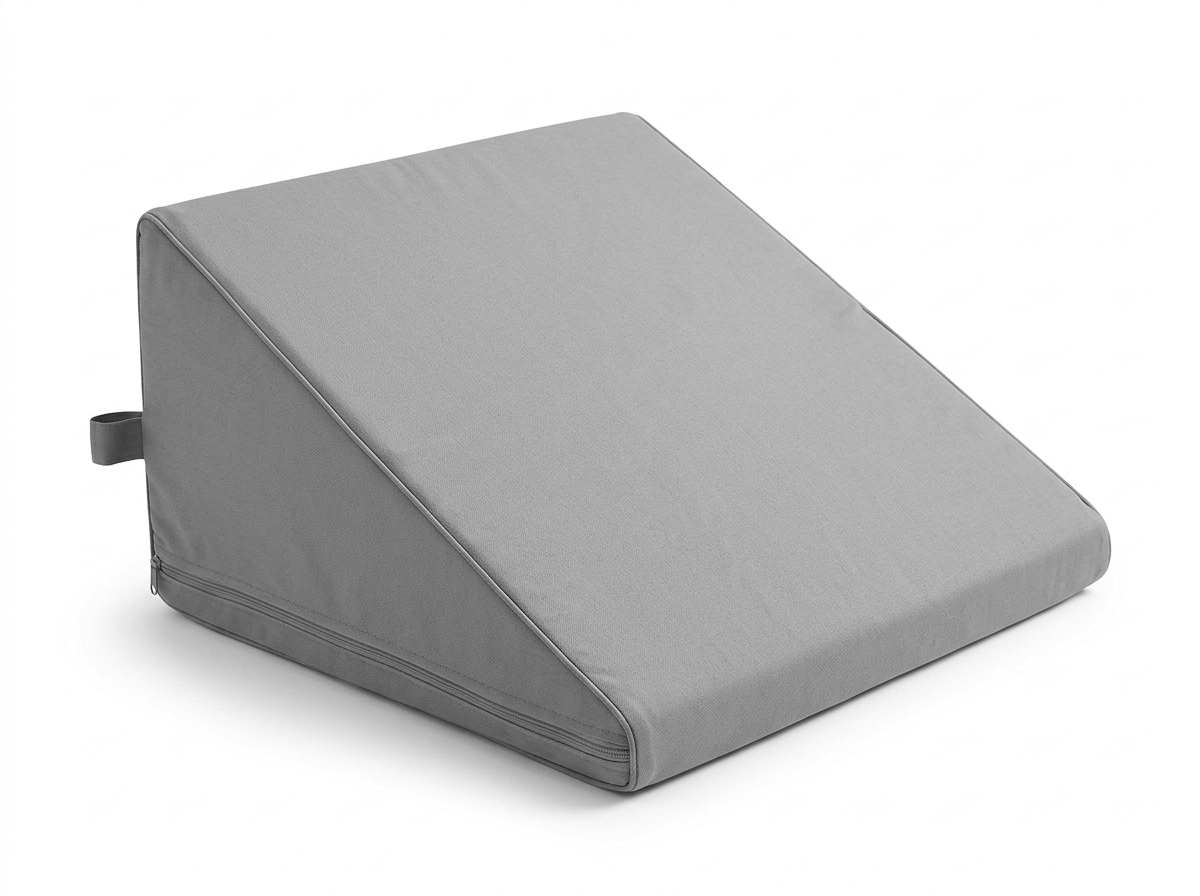
Positioning
Xtra-Comfort Bed Wedge Pillow
A steadier way to sleep propped up than pillows, for someone who is breathless lying flat.
- What it does
- Raises the head and chest so lying down is less uncomfortable
- What it does not do
- Nothing for muscle strength, and nothing for carbon dioxide
- Brands you will see
- Vive, ComfiLife, DMI
- Sizing
- Measure your bed width and check the incline height on the listing before ordering
- Typical price band
- $30 to $60
Honest limitation: a wedge treats the discomfort, not the cause. If someone now needs to be propped up to sleep at all, that is a change the respiratory team should hear about. People can also slide down a wedge overnight, so check in the morning where they actually ended up.
We earn a commission on this link. It does not change the price you pay, and it does not influence which equipment we cover.
When watching is no longer the plan
At some point the answer stops being observation and becomes support. The American Academy of Neurology’s practice parameter says non-invasive ventilation should be considered to treat respiratory insufficiency in ALS, and that starting it early may improve how well people tolerate it. Two pages pick up from here: using BiPAP at home, and cough assist for clearing secretions once the cough itself is too weak.
Common questions
Should I buy a pulse oximeter to check at home?
Not as a safety net. It measures oxygen saturation, not carbon dioxide, and in weak breathing muscles carbon dioxide is what rises first. The 2023 Muscle Nerve review reports nocturnal oximetry has only about 70 percent sensitivity for detecting nocturnal hypercapnia, and the American Lung Association says pulse oximeter numbers should not be used in isolation. If the clinic issues one with instructions, use it their way.
Should we get oxygen at home?
That is the doctor’s decision, not a purchase to make. The 2014 review in the American Journal of Hospice and Palliative Care states supplemental oxygen should typically be avoided in ALS because it may suppress respiratory drive, worsen alveolar hypoventilation, and lead to carbon dioxide retention. In neuromuscular weakness the problem is moving air, and oxygen alone does not move air.
Their breathing seems fine during the day. Can there still be a problem?
Yes, and that is the usual pattern. During REM sleep the body switches off the accessory breathing muscles and leaves the diaphragm working alone. If the diaphragm is weak, carbon dioxide climbs overnight while daytime breathing still looks normal. This is why clinics order overnight testing rather than relying on how someone seems in the chair.
How do I know whether to call today or wait for the appointment?
Use the timescale. A change over weeks goes to the next appointment, written down with dates. A change over days gets a phone call this week. A change over hours, or any confusion, blue coloring, or breathlessness at rest, is emergency services. When in doubt, phone the clinic. Nobody there minds the call.