
Patient lifts
How to Use a Hoyer Lift Safely
A Hoyer lift moves a person who cannot bear weight between a bed, a chair, and a commode without you lifting them. Position the sling under the person, attach the straps to the spreader bar, raise until their weight is fully supported, then steer and lower. Never roll a loaded lift across a threshold or over carpet edges.
Show guidance for someone who
Demonstration with a full-body divided-leg sling on a standard floor lift. Captions and full transcript below.
Before you start
- Lift is charged, or the hydraulic pump moves freely through its full range
- Sling is the correct size and rated above the person’s weight
- Sling has no frayed webbing, torn stitching, or bent clips
- Destination surface is in place, brakes locked, armrest or footrests removed
- Floor path is clear of rugs, cords, and pets
The procedure
Roll the person toward you and place the sling
Roll them onto their side, lay the folded sling along their back with the label facing out, then roll them back over it and pull the sling through from the other side.
The sling label always faces away from the skin. A label turned inward is the most common cause of a pressure mark after a lift.
Bring the leg straps under and across
Pass each leg strap under the thigh and cross it to the opposite side before attaching. Cross for a person who can tolerate it, keep the straps uncrossed for anyone with hip precautions.
Crossing the straps stops the legs from spreading apart during the lift, which is what makes people feel unsafe and grab at you.
Position the base and widen the legs
Roll the lift base under the bed frame and open the base legs to their widest setting using the lever or pedal.
A narrow base is the single biggest tip-over risk on a floor lift. Widen it every time, even for a short transfer.
Attach the sling to the spreader bar
Shoulder loops go on the shorter setting, leg loops on the longer setting. Check that all four attachment points are fully seated and that clips are closed.
Raise slowly until the weight is fully supported
Lift until the person’s hips clear the surface by a few inches. Stop there. Do not raise higher than you need to.
The higher the load sits, the higher the center of gravity, and the easier the lift is to tip.
Steer, do not push the person
Move the lift by its steering handle, keeping one hand available to steady the person. Move slowly and never over a threshold, door track, or carpet transition.
Lower and unhook
Lower until the person is fully seated and their weight is off the sling, guide their hips back into the seat, then unhook all four points and remove or leave the sling per your care plan.
Use caution
- Doing this alone is possible with practice but is not how most manufacturers rate the device. Have a second person for the first several attempts.
- Leaving a sling under someone all day is common practice and is also a pressure injury risk. Check skin at every reposition.
- Weight ratings apply to the lift and the sling separately. The lower of the two governs.
Stop and get help
- The person slides or shifts inside the sling during the lift
- Any webbing is frayed or any stitching is pulled
- The lift drifts downward on its own when raised
- You cannot get the base under the bed and are tempted to lift at an angle
Print the seven-step checklistOne page, large type, tape it to the wall by the bed.
Choosing a lift for home use
Most families do not need the model the hospital used. Manual hydraulic lifts cost a fraction of a powered lift and do the same job, at the cost of pumping a handle roughly fifteen to twenty times per transfer. Choose powered if the caregiver has any shoulder, wrist, or grip limitation of their own.
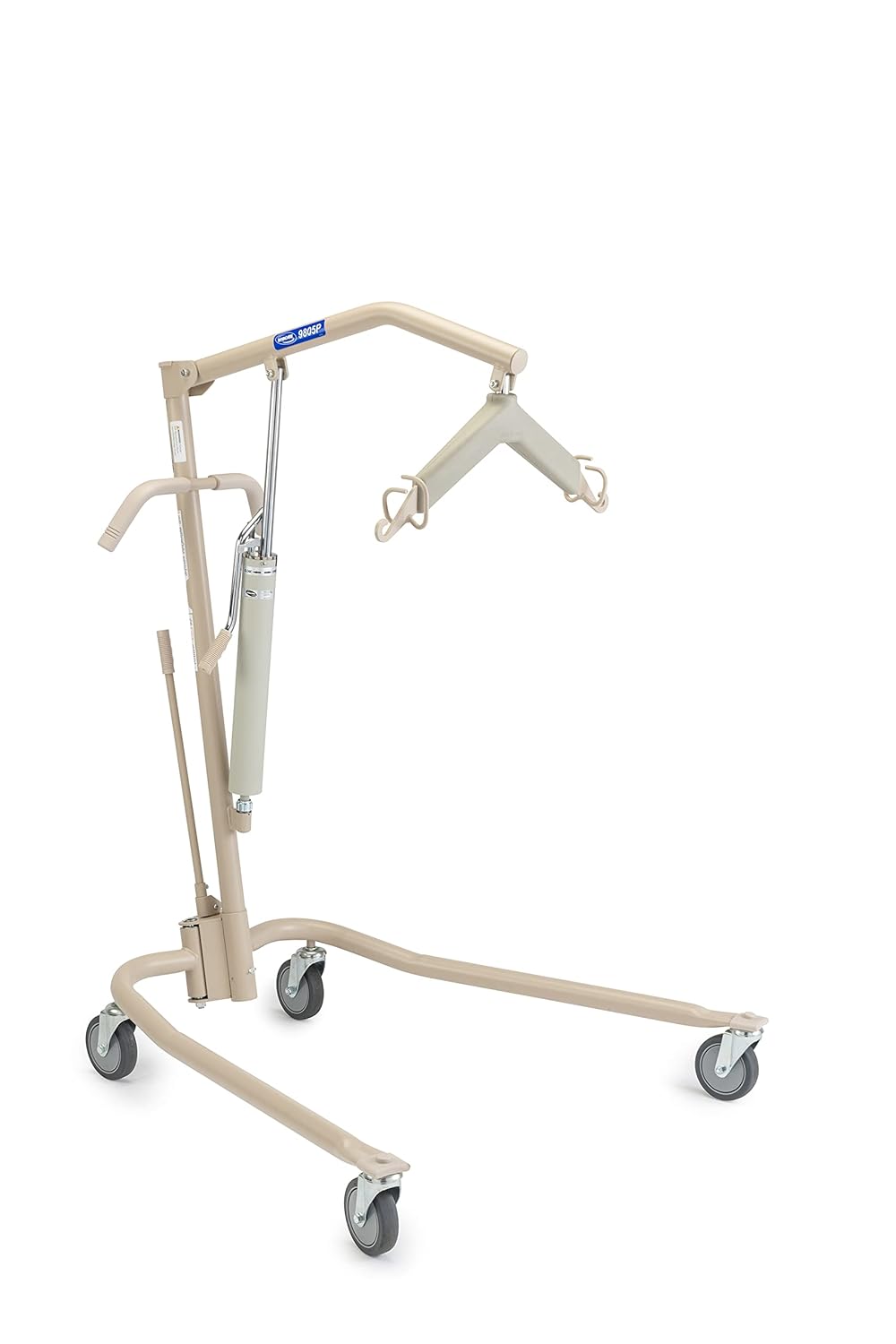
Manual hydraulic
Manual Patient Lift, 400 lb
The usual choice for most homes with a standard bed height and hard flooring.
- Weight capacity
- 400 lb
- Base clearance
- Roughly 4.5 in, clears most standard bed frames but not most platform beds
- Sling included
- Usually one, often the wrong size. Budget for a correctly sized sling separately.
- Typical price band
- $450 to $700
Honest limitation: the base will not fit under a platform bed or a bed with a solid frame skirt. Measure your clearance before ordering anything.
We earn a commission on this link. It does not change the price you pay, and it does not influence which equipment we cover.
Sling sizing at a glance
| Sling type | Best for | Avoid when |
|---|---|---|
| Full body, divided leg | Most home transfers, bed to chair | Hip precautions without clearance from the care team |
| Full body with head support | Weak neck control | Never a downside. Default to this if unsure. |
| Toileting sling | Commode and toilet transfers | Anyone who cannot sit upright unsupported |
| Stand-assist sling | Sit-to-stand lifts only | Any floor lift. These are not interchangeable. |
When this stops working
If transfers are happening more than six or eight times a day, or if the caregiver is starting to have back or shoulder pain, a ceiling track lift is worth pricing out. It removes the steering and the floor clearance problem entirely. Many families wait far longer than they should, and the reason is almost always that nobody told them it was an option.
Common questions
Can one person use a Hoyer lift alone?
Physically, yes, and many caregivers do it daily. Most manufacturers rate the device for two-person use, so doing it alone means accepting that you are outside the rated procedure. Practice with a second person until every step is automatic before you try it by yourself.
Does Medicare cover a Hoyer lift?
Manual patient lifts are generally covered as durable medical equipment with a physician order documenting medical necessity. Powered lifts are covered far less consistently. Full detail is on our equipment coverage page.
How do I know what sling size to buy?
Sling sizing follows the person’s weight and torso length, not their clothing size, and it varies between manufacturers. Measure and use that specific manufacturer’s chart. A sling that is too large is more dangerous than one slightly too small.