
Bed mobility
How to Move Someone Up in Bed With a Slide Sheet
Moving someone up in bed means sliding them toward the headboard on a low friction sheet, not hauling them by hand. Raise the bed to your working height, lay it flat, put a slide sheet under them, and slide with a second person on the other side. Dragging tears the tissue under the skin and hurts your back. OSHA’s nursing home guidance calls this a two person task.
Show guidance for someone who
Before you start
- A second person is available, so one of you stands on each side of the bed
- Bed wheels are locked and the far side rail is up if you have one
- Sheet or pad is checked for frayed fabric, pulled stitching, and handles lifting away from their seams
- Catheter, feeding, and oxygen tubing all have enough slack to travel with them
- The person knows what is about to happen and has agreed to it
- The pillow is free so you can move it to the headboard
The procedure
Raise the bed to your working height
Raise the whole bed until the mattress sits between your hip and your waist, high enough that you can reach across without bending forward.
OSHA’s nursing home guidance puts the working height at the caregiver’s elbows. Leaning over a low bed loads your lower back before you have moved anybody at all.
Lay the bed flat
Lower the head section and the knee section until the surface is flat, unless the care team has told you their head has to stay raised for breathing or reflux.
A raised head section is what slid them down in the first place. Leave it up and you are pushing a whole body weight uphill.
Stand the pillow against the headboard
Take the pillow out from under their head and prop it upright against the headboard.
You are about to slide a head toward a hard board. Nursing assistant training builds this step in for exactly that reason, and it is the one people skip.
Get the sheet under them, shoulders to thighs
Roll them toward one side, lay the folded sheet along their back, roll them back the other way, and pull it through. Our guide to rolling and sitting up at the edge of the bed covers the roll itself.
A sheet that only reaches the hips leaves the shoulders dragging on the mattress. Pulling on a sheet somebody is half on and half off is itself a cause of skin shear.
Take hold at the shoulder and the thigh
Turn your front foot toward the head of the bed and grip the top layer, or its handles, close to their body at shoulder level and upper thigh level. Your helper mirrors you.
Those two points carry the trunk. Hands at the head and the feet let the middle sag, and the hips arrive last.
Slide on an agreed count, never lift
If they can help, ask them to bend their knees and push through their feet on three. Shift your weight from your back foot to your front foot and let the sheet glide.
The sheet works by letting two surfaces slip past each other. The moment you lift, you are carrying them again and the sheet is doing nothing for you.
Take the sheet back out
Take the far top corner and fold it back under itself, working hand over hand down the bed until it pulls free.
Slide sheet guidance is that they never stay under a person. Left in place, a low friction layer turns the bed into a slope and its own folds become a pressure point.
Check the skin before you resettle them
Look at the tailbone, both heels, both hips, the shoulder blades, and the back of the head. Then smooth the bottom sheet flat and put the pillow back.
The international pressure injury guideline asks you to look for early skin and tissue damage at every reposition, not once a day. Redness that will not fade, a warm or cool patch, or any shiny or purple area gets reported the same day.
Use caution
- Never pull someone up by their arms or under their armpits. The shoulder does not take that pull well, and this is a common way to injure one.
- One person pulling from the head of the bed is the highest risk version of this task. OSHA’s nursing home guidance names it and says not to do it.
- Do not start the pull while they are only partly on the sheet. Half on and half off shears skin instead of protecting it.
- A slide sheet moves someone along a surface. It does not lift them off one. Bed to chair still needs a lift or a stand assist.
- This page does not replace hands on teaching. Ask the physical or occupational therapist on the case to watch you do it once.
Stop and get help
- A red mark over a bony point that does not fade when you press it
- Skin that is broken, blistered, or has a shiny, purple, or boggy patch over the tailbone, heels, or shoulder blades
- Fabric that is frayed, stitching that is pulled, or a handle coming away from its seam
- They slide straight back down within minutes, every single time
- There is only one of you and the person cannot help with the move at all
Print the eight-step checklistOne page, large type, tape it to the wall by the bed.
Choosing a slide sheet or a positioning pad
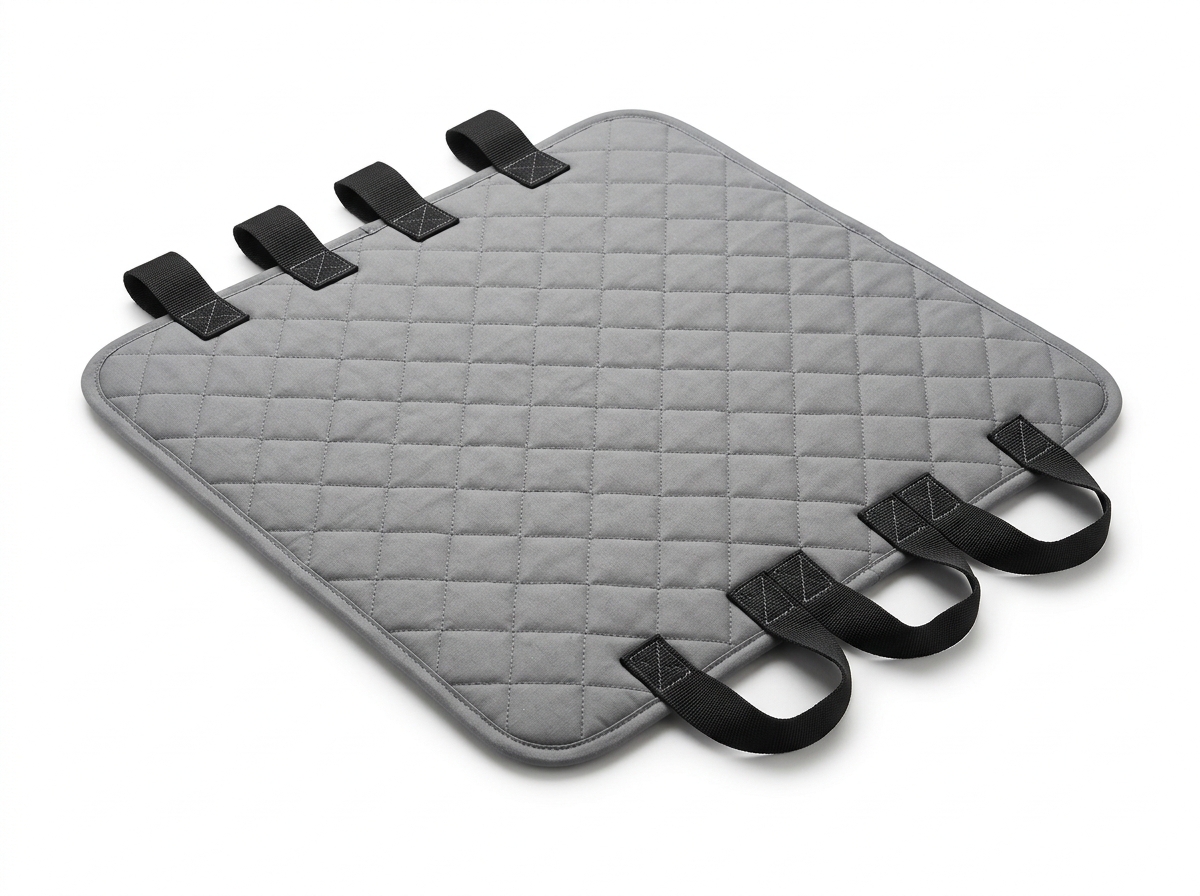
Two different products get sold for this job. A true slide sheet is two low friction layers that glide over each other, which is what hospital handling training uses. A padded positioning pad is one layer with sewn handles, giving you a grip and a barrier between skin and mattress. The pad is easier to learn. The two layer sheet takes less effort once you have the knack.
Bed mobility
Vive Positioning Bed Pad with Reinforced Handles
Where most families start, because the handles tell you where to hold and there is nothing to learn.
- Weight capacity
- 300 lb
- Size
- 35 in by 34 in, so it spans shoulders to mid thigh on most adults
- Reusable
- Washable and reusable, per the listing
- Typical price band
- $22 to $35
- Caregivers needed
- Two, one on each side of the bed
Honest limitation: it is a single padded layer, so it protects skin and gives you a grip but it does not glide the way two low friction layers do. You still supply the effort. Confirm the capacity printed on your own unit before you rely on it, and confirm it covers the person’s weight.
We earn a commission on this link. It does not change the price you pay, and it does not influence which equipment we cover.
Whatever you buy, the sizing question is simple. It has to reach from the shoulders to below the buttocks, because those are the two places the weight sits. Anything shorter and you are back to dragging the half of the body the sheet does not cover.
When this stops working
If they slide down again within an hour of every reposition, the bed is the problem and not your technique. A hospital bed with a knee break holds the hips in place, and it is worth asking the care team whether one is justified.
If a second person is not reliably there, or the main caregiver has back or shoulder trouble, OSHA lists air assisted sliding aids as an alternative and a ceiling track lift removes the pull entirely. The bed and pressure care catalog covers the middle ground, and a full body lift is the next step after that.
Common questions
Can one person move someone up in bed alone?
OSHA’s nursing home ergonomics guidance calls repositioning in bed “not a one person task” and says specifically not to pull from the head of the bed. If the person can push with their feet, a small assisted scoot is a different job. Moving someone who cannot help at all needs two people.
Why is dragging so bad if it gets them up the bed?
Because the skin stays stuck to the sheet while the bone and tissue underneath keep traveling. That is shear, and it is one of the main mechanisms behind pressure injuries. The international pressure injury guideline asks caregivers to use equipment designed to reduce friction and shear instead.
Can I leave the slide sheet under them between moves?
No. Slide sheet guidance is that it comes out as soon as the move is finished. A low friction layer left in place means they slide back down again, and it is not something to leave under someone unattended.
How often should someone be repositioned?
There is no one interval that fits everybody. The 2025 international guideline asks for a schedule set around the individual person: their mobility, their skin tolerance, their comfort, and their medical condition. Ask the nurse or therapist who knows their skin what interval they want, and write it down where the whole household can see it.