
Walking aids
Walker vs Rollator: Which One Do You Actually Need?
A standard walker has four legs and no wheels. You lift it, set it down, then step. That is why it gives the most support and the slowest walk. A rollator rolls on four wheels, has brakes and a seat, so it never has to be lifted. Choose the walker when balance is the problem, the rollator when stamina is. Getting that backward is how people fall.
Show guidance for someone who
Before you choose
- Watch them walk across a room without any device, and note what fails first: balance, or breath
- Check whether both hands can grip, squeeze and hold
- Measure the narrowest doorway and the tightest turn in the house
- Ask where they stop and hold onto furniture, and how often
- Ask a physical or occupational therapist to confirm the choice if you can get an appointment
The difference that matters
Everything else is detail. A standard walker has to be picked up and put down with every step, so it is only ever taking weight when all four legs are on the floor. In exchange you get a rigid frame that does not move when you lean into it.
The Health in Aging Foundation, the public education arm of the American Geriatrics Society, puts it in weight terms: a cane can support up to about a quarter of your body weight, while a walker can support half or more.
A rollator never has to be lifted. That is the whole point of it, and it is a real advantage for anyone who runs out of breath or energy.
A 2010 study of older adults who depend on a walking aid measured the physiological cost index of walking at 2.01 with a fixed walker against 1.23 with a rollator. The authors put it down to the repeated effort of lifting the frame, and said the fixed model should be avoided in cardiac or respiratory conditions.
A Canadian Agency for Drugs and Technologies in Health review of wheeled against non-wheeled walkers found the same pattern: people using a frame with no wheels covered shorter distances and used more energy. That same review was blunt about how thin the evidence is, and warned it should be read with caution. There is no study that picks your device for you.
Walker, rollator or cane at a glance
| Device | How it moves | Choose it when | What it costs you |
|---|---|---|---|
| Single point cane | Held in one hand, lifted and placed | One weak or painful side, mild unsteadiness, and good standing balance | Supports only about a quarter of body weight, and it does nothing for a backward loss of balance |
| Standard walker, no wheels | Lifted and set down with every step | Balance is the main problem and they need something that will not move when leaned on | Slow, tiring, and it breaks the rhythm of walking. Needs enough arm strength to lift the frame |
| Two wheel walker | Front wheels roll, rear legs slide on glide caps | Lifting the frame is too tiring but they still want to lean forward into it | Less stable than a fixed frame, and the rear legs can catch on thick carpet |
| Four wheel rollator with seat | Rolls freely, stopped by hand brakes | Balance is fair, stamina is short, and both hands can work the brakes | It rolls. Lean on it unbraked and it goes. Needs hand strength and more turning room |
Why the wrong choice causes falls in both directions
People assume the risk runs one way, that too little device is dangerous and too much device is merely inconvenient. It does not work like that.
Too little device is the obvious failure. Someone who needs a frame is given a cane, and the first time they lose balance backward there is nothing behind them.
The other version is quieter. Someone who needs a rigid walker is given a rollator, leans onto the handles to stand up, and the wheels take it away from under them. It happens to people who were doing fine with the same device an hour earlier.
Too much device is the failure nobody warns you about. Researchers at the CDC, publishing in the Journal of the American Geriatrics Society, estimated 47,312 walking aid related fall injuries treated in United States emergency departments each year, of which 87.3 percent involved walkers and 12.3 percent involved canes. Roughly a third of those people were admitted to the hospital. Fractures and contusions were the most common injuries.
Read that carefully, because it is easy to misread. It does not prove walkers are dangerous, and it does not say how many people were using each device. It does tell you that a frame in front of a person is one more thing to trip on, and one more thing to catch on a threshold. A device you cannot manage is not a safety net.
When a cane is still enough
A cane is enough when a single steadying hand is enough. That is the test used in the clinical literature on choosing a walking aid: if one assisting hand helps them walk, a cane may help. If they reach for two hands, or for the wall, they have already told you they need a frame.
The Cleveland Clinic puts the limit at 25 percent of body weight for a cane against about half for a walker, and adds that you need upper body strength and an upright posture to use one safely. Quad canes are not the upgrade they look like: the Health in Aging Foundation says they are not ideal for most people, because they do not give the stability four feet suggest.
The other thing a cane cannot do is carry things, and it has nowhere to sit. If the reason someone stopped walking to the mailbox is that they cannot make it back, no cane solves that. Our walking aids catalog lays the options out side by side.
Use caution
- The names get used loosely. A store may call a rollator a walker. Look at the wheels and the seat, not the label on the box.
- Rollator brakes take hand strength. Have them squeeze and lock both brakes themselves before you buy anything.
- Never push up from the handles of either device to stand. Push up from the chair arms, then take the handles once standing.
- Weight ratings differ between models and between size variants of the same model. Read the label on the frame you actually own.
- MedlinePlus warns against using stairs or escalators with a walker unless a physical therapist has trained you on it.
Stop and get help
- The device rolls or slides away from them, even once
- They hang on the frame rather than walking upright inside it
- Their toes catch on the floor, a rug edge, or the front wheels repeatedly
- Either hand can no longer squeeze and hold a brake
- New numbness, tingling or hand weakness appears after a few days of using the device
Set the handle height before the first walk
This is the adjustment most home devices never get. Have them stand as straight as they comfortably can, shoulders relaxed, arms hanging at their sides. The top of the handle should line up with the crease of the wrist. The Cleveland Clinic gives the same rule for a cane, and adds that the elbow should then bend about 20 degrees.
The clinical guidance on cane length says the same thing two ways: measure from the floor to the wrist crease or to the greater trochanter, the bony point at the side of the hip, and expect 20 to 30 degrees of elbow flexion in use. MedlinePlus describes walker handles as sitting at hip level with elbows slightly bent. All three descriptions land in the same place on a real body.
Two checks tell you the height is wrong. If they bend forward at the waist to reach the handles, the device is too low. If their shoulders ride up toward their ears, it is too high. Both are named as problems by the Health in Aging Foundation, and both put strain into a neck and back that were already working hard.
One more habit worth fixing early. MedlinePlus says to place the walker only a few inches to an arm’s length ahead, get all four tips or wheels down before stepping, and keep your toes inside the frame. Pushing the frame too far out in front turns it from support into a thing to fall over. The same body position carries into rolling walker transfers.
Print this comparisonOne page, large type, take it to the appointment or to the store.
The two devices, side by side
Prices for both sit low enough that some families buy the walker first, learn what actually fails, and then buy the rollator. That is not a wasteful order. The walker tells you quickly whether the problem is balance or breath.
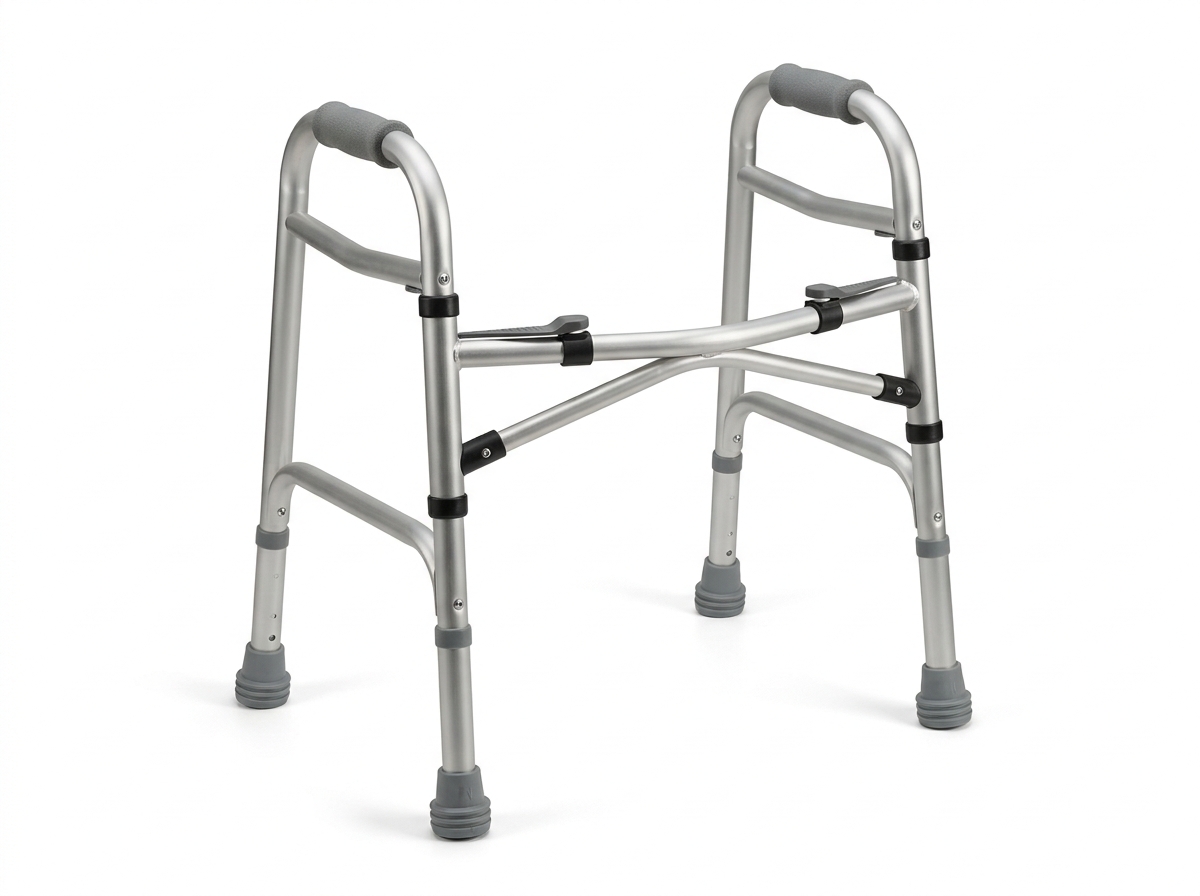
Standard walker
Drive Medical 2-Button Folding Walker
The stable option. Pick this when the thing that fails first is balance, not breath.
- Weight capacity
- 350 lb for this model. Other walkers differ, so read the label on the one you own.
- Wheels
- None. It is lifted and placed with every step.
- Folding
- Two-button folding, so it goes flat into a car trunk.
- Best distance
- Short indoor trips. It is not the device for a long walk.
Honest limitation: it has to be lifted every single step. That is exactly the effort the 2010 energy study pointed at when it measured a physiological cost index of 2.01 with a fixed walker against 1.23 with a rollator. If someone is short of breath or has a heart condition, this is the wrong frame.
We earn a commission on this link. It does not change the price you pay, and it does not influence which equipment we cover.
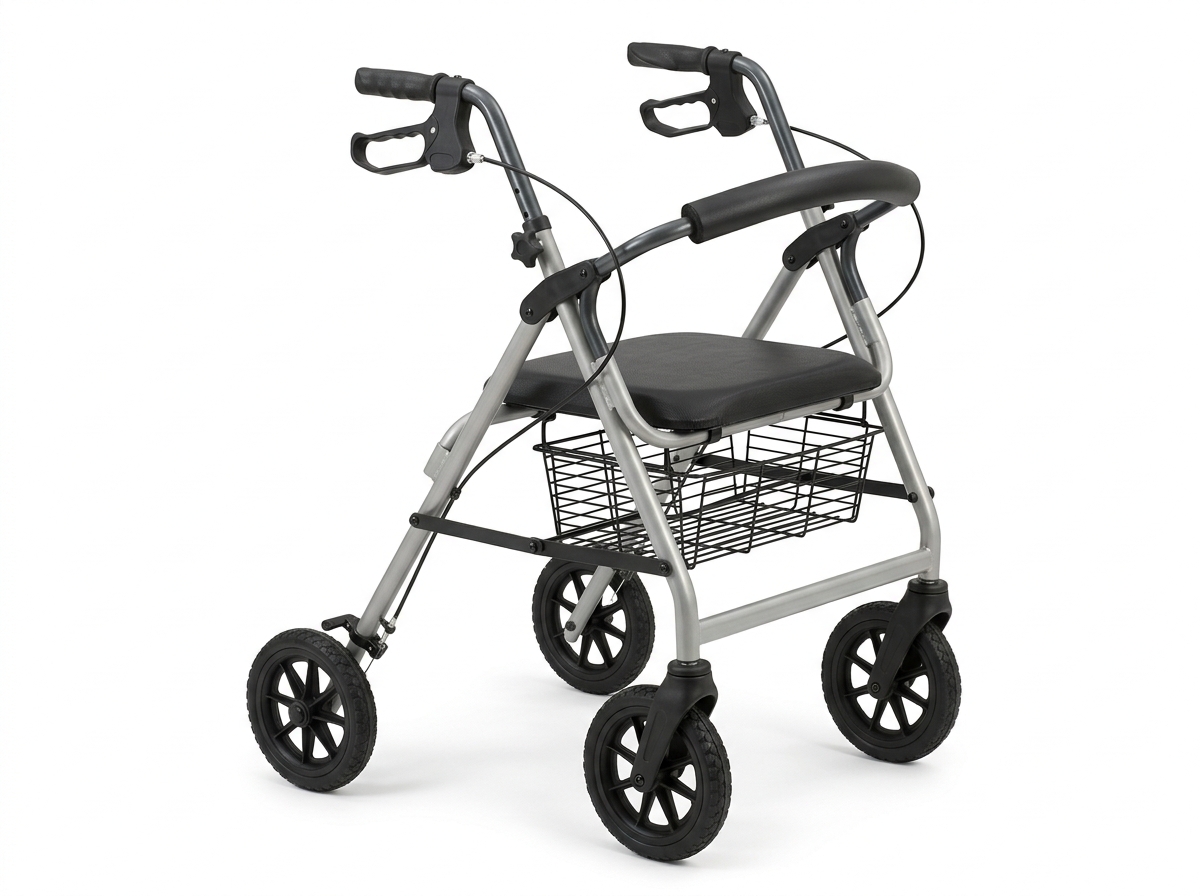
Four wheel rollator
Drive Medical Nitro Foldable Rollator with Seat
The distance option. Pick this when they can balance but cannot last, and both hands work the brakes.
- Weight capacity
- Not stated in this listing. Check the rating printed on the frame before anyone sits.
- Brakes
- Hand brakes that squeeze to slow and press down to lock. Test the grip before buying.
- Seat
- Yes, for resting only, with the brakes locked and both feet on the floor.
- Sizing
- This is the standard height version. Tall and heavy duty variants are separate models.
Honest limitation: it rolls, and that is not always a feature. Lean on an unbraked rollator to stand and it will move away from you. Anyone who needs to push down hard through their arms to get upright needs a fixed frame instead, or a different plan for standing.
We earn a commission on this link. It does not change the price you pay, and it does not influence which equipment we cover.
The seat is a rest stop, not a ride
For a lot of people the seat is the reason to choose a rollator at all. Fatigue sets the limit on where someone goes long before balance does. A seat that travels with them turns the pharmacy, the yard and a friend’s kitchen back into places they can reach, because there is always somewhere to stop.
Use it the way the manufacturer manuals describe. Lock both brakes before anyone sits. Sit on level ground, never on a slope. Keep both feet flat on the floor, and do not twist or reach for something while seated, because that shifts the weight and the frame can tip.
The seat is not a wheelchair. Rollator manuals say plainly not to push a person while they are sitting on it, and not to use the seat to move people or objects. If someone needs to be pushed, they need a transport chair, and that is a different purchase.
Foot drop, and what an ankle foot orthosis does
Sometimes the device is not the problem. If the toes catch on the carpet, if one foot slaps the floor, or if someone has started lifting a knee higher on one side to clear the ground, look at the ankle before you buy a bigger frame.
The NHS describes foot drop as difficulty lifting the front part of the foot and toes, usually on one side, which changes the way a person walks. Causes it lists include injury to the nerve that runs down the leg, nerve problems from diabetes, hip or knee surgery, and damage from stroke, cerebral palsy, Parkinson’s disease or multiple sclerosis. Motor neuron disease can cause it too.
An ankle foot orthosis is the brace used for it. It holds the foot in position so the toes clear the ground as the leg swings through. The NHS lists a brace, splint or shoe insert alongside physiotherapy, electrical stimulation devices and, in some cases, surgery. It is a way to make walking safer, not a treatment for whatever is causing the weakness.
Get it fitted by a clinician. A 2023 review of ankle foot orthosis and electrical stimulation research in multiple sclerosis found the results vary with the person’s level of disability, the walking environment and what they are trying to do. The value is in a clinician choosing the right device for the right person. A brace that fits badly rubs and can make walking less safe.
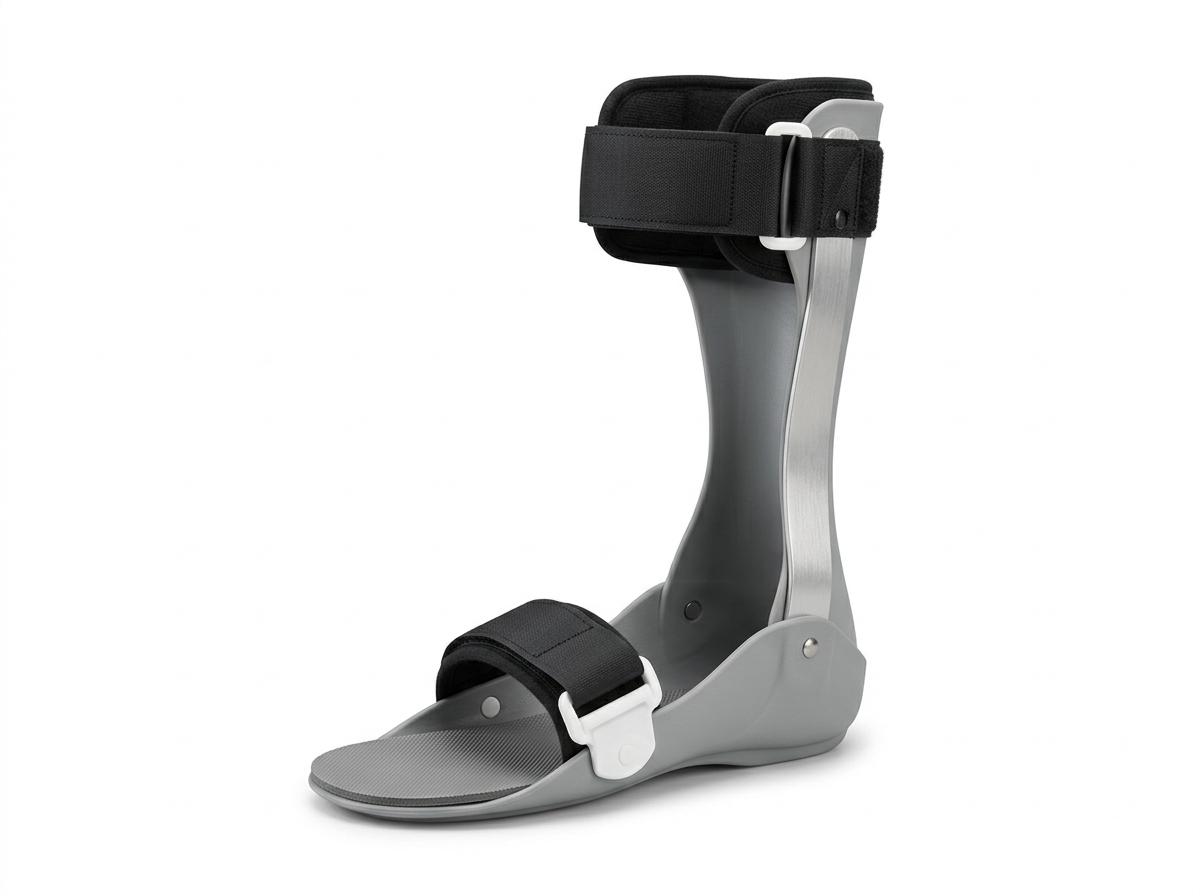
Ankle foot orthosis
BraceAbility Soft AFO Foot Drop Brace
A soft, off the shelf brace worn with a shoe. Ask a clinician first, then buy.
- Fitted by
- A clinician. An orthotist, physical therapist or occupational therapist should confirm the type and the fit.
- Type
- Soft adjustable dorsiflexion assist brace, worn inside a shoe, fits left or right.
- Sizing
- This listing is the S/M size. Sizing is by foot and calf, so check the chart against a measurement.
- What it does
- Holds the foot up so the toes clear the floor during the swing of the leg.
Honest limitation: a soft off the shelf brace is not the same thing as a fitted orthosis, and it is no substitute for an assessment. It does nothing for the underlying weakness, it can rub the skin over the shin and heel, and a rigid brace is often the right answer instead. Check the skin every time it comes off.
We earn a commission on this link. It does not change the price you pay, and it does not influence which equipment we cover.
When this stops working
Walking aids run out when the arms run out. Once someone cannot lift a walker, cannot hold a brake, or is being steadied by you on every trip, no frame fixes that. The next steps are a transport chair for distance and the seated methods on our rolling walker transfers page. If you are already steadying them by hand, read how to do that safely with a gait belt.
Common questions
Is a rollator just a walker with wheels?
No, and the difference is not cosmetic. A standard walker is stationary every time it takes weight, so it can be leaned on. A rollator only stops when the brakes are held or locked. That makes it faster and far less tiring, and it makes it the wrong choice for someone whose balance is the problem.
What if their hands are too weak for the brakes?
Then a four wheel rollator is not safe for them, however much they want the seat. Have them squeeze and lock both brakes themselves before you buy. If they cannot, look at a two wheel walker or a standard frame, and ask a therapist about the options in between.
Does insurance cover a walker or a rollator?
Coverage depends on your plan, the documentation from the prescriber, and which category the device falls into, and the rules change. Ask the supplier to confirm in writing before you pay. Our page on free and low cost equipment covers loan closets and reuse programs, which are often faster than a claim.
Do we need an ankle foot orthosis if they already use a walker?
Possibly, because they solve different problems. A frame gives support. A brace holds a weak foot up so the toes clear the ground. If the toes are catching or one foot slaps down, that is an ankle problem and a bigger frame will not fix it. Ask a clinician to look at the ankle.