
Falls
What to Do When Someone Falls, and How to Get Them Up
Do not lift them. Kneel down, ask what hurts and whether they hit their head. If they are uninjured and can follow instructions, coach them up: roll onto their side, up onto hands and knees, then stand using a sturdy chair while you steady them. If they cannot, keep them warm and call for help. Never take a fallen adult’s weight through your arms or a gait belt.
Show guidance for someone who
Before you start
- They are awake and answering you in a normal voice
- You know whether they hit their head, and whether they take a blood thinner
- Nobody has already tried to pull them up by the arms
- A sturdy chair or a low solid piece of furniture is within reach
- Your phone is in your hand, not in another room
- You know your fire department’s non-emergency number
The procedure
Get down to their level
Kneel beside their head where they can see and hear you without lifting or turning their neck.
Standing over someone on the floor makes them crane upward to answer you, which is the one movement you want to avoid until you know their neck is fine.
Check for injury before anything else
Ask what hurts, ask whether they hit their head, and look at the head, hip, and legs before you discuss getting up. CDC’s STEADI fall prevention program puts checking for injury first, ahead of any attempt to stand.
The NHS manual handling procedure for fallen people is blunt about this: if there is any doubt, the person should be left safe on the floor and medical assistance requested.
Call 911 if you see a red flag
Hip or back pain, any suspicion of a broken bone, a head strike, confusion, heavy bleeding, or a blood thinner in their medication list all mean you stop here and call.
MedlinePlus first aid guidance says not to move the person unless it is absolutely necessary, and to keep the head in line with the spine if a neck injury is possible. A suspected hip fracture needs to be moved flat, by people trained to do it.
Give them a few minutes on the floor
Let them lie still and breathe until their heart rate settles, even when they are embarrassed and want to be up immediately.
CDC advises taking your time before getting up even if you think you are fine. Physical therapists quoted by AARP make the same point: standing too fast is how the second fall happens, minutes after the first.
Set a sturdy chair within their reach
Bring a solid chair to them and place it near their head, or point them at the nearest stable piece of furniture if the chair will not reach.
The NHS procedure has the handler position the chair before the person starts moving. Chair first means they never end up stranded on hands and knees with nothing to push against.
Ask them to roll onto their side
Have them roll toward their stronger side and bring the top hand flat on the floor in front of the chest.
Ask them to push up onto hands and knees
Have them press through that hand into a half sitting position, then onto all fours, facing the chair. Keep your hands near their shoulders without taking any weight.
This staged method is called backward chaining. The NHS procedure lists its requirements plainly: the person has to be able to roll onto their side, kneel, and follow instructions. If any one of those is missing, this is not the right method.
Ask them to place the stronger foot flat
With both forearms leaning on the chair seat, have them bring their stronger leg forward and set that foot flat on the floor.
A foot placed on its toes slides out the moment they load it. Flat means the whole sole, heel included.
Steady them as they push up into the chair
They push through the chair seat and that front leg and turn to sit. You keep your back upright, your hands on their shoulder and hip, and you steady only.
An occupational therapy professor quoted by AARP puts the risk in one line: there is a high risk of injury for partners or caregivers who try to help someone up when that person is dead weight. Your job here is balance, not power.
Use caution
- Applying the revised NIOSH lifting equation to patient handling gives a 35 pound maximum for a manual lift, and only when the person is cooperative and will not move suddenly. Above that, use equipment.
- Two caregivers lifting an adult off a floor by hand is still a manual lift. It splits the load, it does not make it safe.
- Never lift under the armpits. The ALS Network tells caregivers not to grab arms, clothing, or belt loops during any transfer.
- Once they are seated, sit with them for a few minutes and check again for pain that was masked by adrenaline.
- A fall that happens once tends to happen again. NCOA reports that nearly half of lift assist calls are followed by a second one within two weeks.
Stop and get help
- They hit their head, or you cannot get a clear account of what happened
- Any CDC head injury danger sign: worsening headache, repeated vomiting, slurred speech, one pupil larger than the other, a seizure, extreme drowsiness, increasing confusion, or any loss of consciousness
- Hip, back, or neck pain, or anything that makes you suspect a broken bone
- They cannot roll onto their side, cannot kneel, or cannot follow your instructions
- They have been on the floor for an hour or more
- You find yourself taking their weight instead of steadying them
Print the nine-step checklistOne page, large type, tape it inside a kitchen cupboard door.
How to lift someone off the floor after a fall when they cannot get themselves up
This is the situation the search brought you here for, and the honest answer is that you do not lift them. You get equipment or you get people. A cohort study that followed adults over 90 for a year found that 80 percent were unable to get up after at least one fall, so needing outside help is the normal outcome, not a failure on your part.
Meanwhile, keep them on the floor and keep them comfortable. NHS advice for people waiting on the floor is to cover up with a blanket, coat, or dressing gown, especially over the legs and feet, and to change position roughly every half hour to protect the skin. Put a cushion under the head. Stay where they can see you.
Call your fire department for a lift assist
Many US fire departments will send a crew to pick up an uninjured person who has fallen, and in many places it is free. South Metro Fire in Colorado tells residents plainly: if you are not injured but cannot get up on your own, call 911 and ask for a lift assist.
Asked what a lift assist costs, that department’s answer is “not a penny. You have already paid for the fire department’s services through your taxes.”
Where cities have added lift assist fees, they are aimed at licensed care facilities, not families. Everett, Washington charges nursing and assisted living facilities and states that the fee “does not apply to individuals calling from their personal residences.” Raleigh, North Carolina exempts private residences and independent living the same way.
Policies do vary by town, so make one phone call on a calm day rather than at midnight on the floor. Ask your fire department’s non-emergency line whether they do lift assists, whether they charge, and which number they want you to use. Write the answer on the fridge. Use 911 anyway, without hesitating, if there is any injury or any sign of a medical emergency.
Lifting cushions and floor-capable lifts
An inflatable lifting cushion sits under the person and raises them from the floor to seat height on air, with no lifting by you. The NHS procedure sets one clear condition: the person must be able to hold their own sitting balance without support, and must be sitting centrally on the cushion before it is inflated. Check the safe working load printed on the model itself.
A full-body patient lift is the other route, and it works from the floor if the model reaches that low. The ALS Network says it directly: should you ever fall, your patient lift can also help lift you off the ground.
Read your own lift’s manual for its minimum lifting height before you count on it, and get a PT or OT to walk you through a floor pickup once, on a day when nobody has fallen. Our guide to using a Hoyer lift safely covers sling placement and the base width that keeps the lift stable.
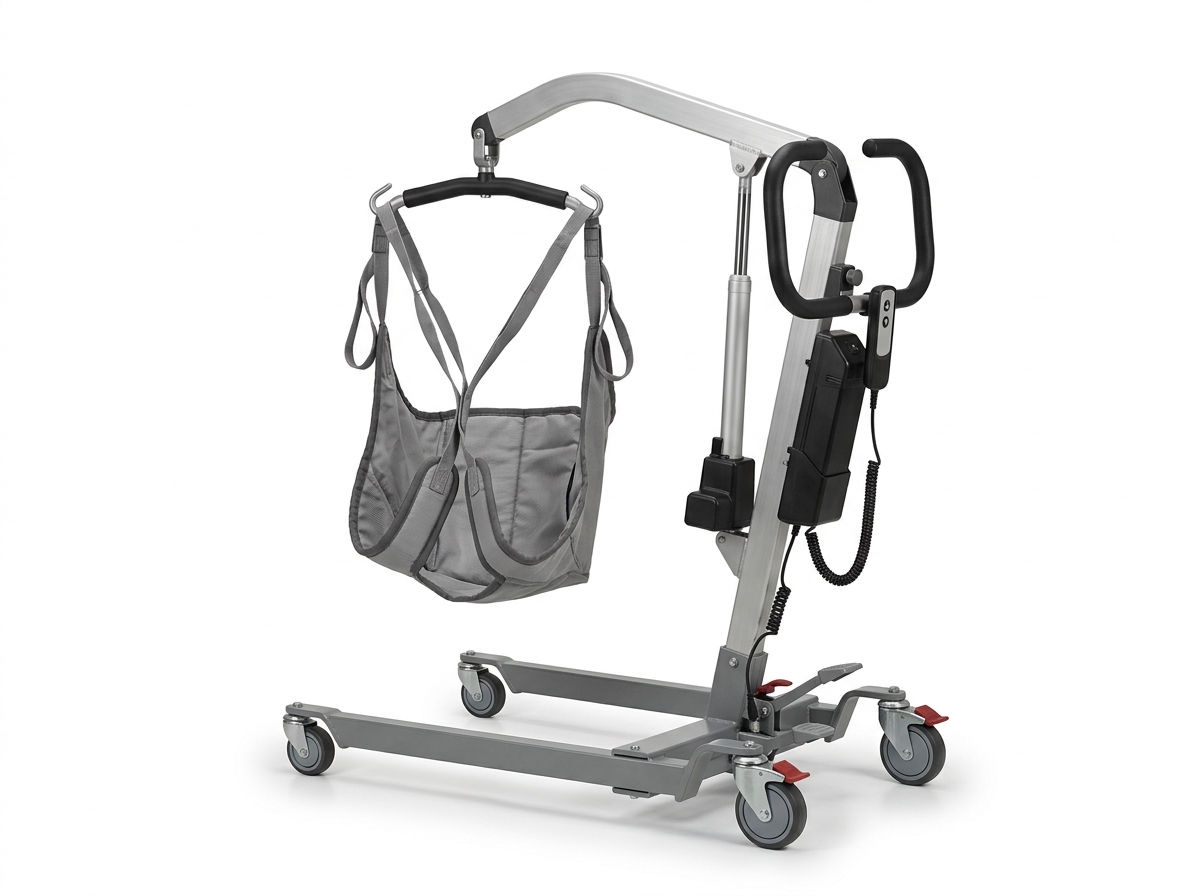
Powered full-body lift
ProHeal Electric Lift
The version families buy when floor pickups have started happening and the caregiver cannot keep pumping a hydraulic handle.
- Weight capacity
- 500 lb
- Spreader bar
- 6 point
- Rated uses
- Manufacturer lists floor, low bed, and chair lifting. Confirm the minimum lifting height in your unit’s manual.
- Typical price band
- $700 to $1,600
- Sling
- Sized separately, to the person. Inspect webbing and stitching before every single use.
Honest limitation: a floor lift only helps where its base fits. If the fall happened in a bathroom, a hallway, or the gap beside a bed, you may not be able to get the legs around the person at all, and you are back to calling for a lift assist.
We earn a commission on this link. It does not change the price you pay, and it does not change what we recommend.
When this stops working
Once the chair method fails twice, or you have called for a lift assist more than once in a month, the answer is not a better technique. It is a reassessment.
Ask the neurologist or primary care office for a home visit from a PT or OT who can watch a real transfer and say what has changed. The ALS Network says a PT or OT should train the household on a patient lift at home. Ask for that by name.
At the same time, fix the reachable help problem. In that study of adults over 90, 30 percent had lain on the floor for an hour or more, and long floor times were strongly associated with serious injury, hospital admission, and moving into long term care. Alarms worked when they were actually used. A phone in a pocket or a pendant that gets worn beats one charging in the kitchen.
Common questions
Can I use a gait belt to lift someone off the floor?
No. A gait belt gives you a handhold to steady someone who is bearing their own weight. It is not a lifting device and it is not rated to take a person’s body weight. Using one to haul someone off a floor is a common way for caregivers to injure their own back. Our guide to fitting and using a gait belt covers what it is actually for.
Will the fire department charge me for a lift assist?
In most places, not at a private home. Cities that have added lift assist fees, such as Everett, Washington and Raleigh, North Carolina, apply them to licensed care facilities and exempt private residences. Policies differ, so call your own fire department’s non-emergency line and ask before you need the answer.
Should I call 911 or the non-emergency number?
Call 911 for any injury, any head strike, any confusion, any chest pain or trouble breathing, or anything you cannot explain. Use the non-emergency line when the person is clearly uninjured, is talking normally, and simply cannot get up. Some departments, including South Metro Fire, still want you to call 911 and say the words “lift assist” so the dispatcher can size the response correctly.
How long can someone safely stay on the floor?
Less time than you would guess. Lying on the floor for an hour or more is strongly associated with serious injury, hospital admission, and later moves into long term care. If you cannot get them up within a few minutes, stop trying, keep them warm, and call for help rather than making repeated attempts.
Do I need a second person to help?
For coaching someone up with a chair, one person is enough, because they are doing the work. For any situation where weight has to be moved, the second person you want is not another family member, it is a fire crew or a lift. Two people lifting an adult off a floor by hand is still a manual lift.