
Bathroom transfers
Toilet Transfer Techniques, Including Tight Bathrooms
A toilet transfer moves someone from a wheelchair or walker onto the toilet and back. Bring the chair in at the closest angle the room allows, loosen clothing before they stand, have them push up through a fixed grab bar or frame, then turn by stepping their feet. Whatever they hold has to be bolted to something structural. A suction bar steadies balance, it does not take weight.
Show guidance for someone who
Before you start
- Floor is dry, and the bath mat, bin, and scale are out of the transfer path
- Wheelchair brakes are locked and tested, footrests swung away or removed
- Grab bar or frame does not move when you pull hard on it yourself
- Toilet lid is up, seat is down, and the shelf above the tank is clear
- Clothing is loose enough that you can move it with one hand
- You have said what is about to happen and they have agreed to it
The procedure
Bring the chair in at the closest angle the room allows
Get the front of the seat as near to the front of the toilet as the space lets you, angled in toward their stronger side.
Occupational therapy teaching sets the two surfaces at about 90 degrees to each other. Most home bathrooms will not give you that. A tighter angle is the correct compromise, because the distance their hips have to travel matters more than the geometry.
Loosen the clothing while they are still seated
Undo the button, the belt, or the waistband now, before anyone stands. Leave the clothing up on the hips for the moment.
Fumbling with a fastening while someone is standing means one of your hands, or one of theirs, comes off the support at the exact second their balance is worst.
Set their feet flat and under their knees
Place both feet flat on the floor, heels drawn back so the ankles sit under or slightly behind the knees.
Feet left out in front turn the stand into a pull. They cannot push up through a leg that is already extended, so the load lands on you.
Bring them forward to the front of the seat
Shift their hips forward in small side to side movements until they are perched near the front edge.
Stand on an agreed count
Their hands go on the grab bar or the frame arms, never on you. Count out loud, keep your own feet wide, and bend your knees as they rise.
Hands on your neck or shoulders pull you forward and take away the wide, stable stance that protects your back. This is a stand pivot, and it only works while they can take weight through their legs.
Turn by stepping their feet, never by twisting
Move them around in several small steps until the backs of both legs touch the toilet or the raised seat.
A twist with the feet planted loads the knee sideways, and it is the movement that injures caregivers’ backs. The calves touching the seat is the signal that they are far enough around.
Lower the clothing once they are steady
With both of their hands still on the bar or the frame, bring the clothing down clear of the seat in one movement.
Access Board research on bathrooms designed for assisted transfers found that bars on both sides of the toilet are what let someone hold their balance while clothing is removed or replaced. That is the whole reason this step happens here and not earlier. The Access Board is the independent US federal agency that writes accessibility standards for buildings.
Lower them to the seat under control
Ask them to reach back for the frame arms, keep your knees bent, and let them down slowly rather than letting them drop the last few inches.
Leave the bar and the call bell within reach
Before you step out, put the toilet paper, the bar, and whatever they use to call you inside arm’s reach from where they are sitting.
Use caution
- Drive Medical’s own instruction sheet for its suction cup bars says the bar “is to be used as a balance assist only” and “is not intended to support body weight”. Treat every suction bar that way.
- UF Health is blunt about the alternative people grab in a panic: “Do not use towel racks as grab bars. They can’t support your weight.” The same goes for the sink and the tank lid.
- If their feet cannot reach the floor once a raised seat is fitted, the seat is too tall for them. NHS guidance is to not use it.
- Do not fit a raised seat if the toilet’s own bowl or tank fittings are loose, or if the brackets have worked loose since last time.
- Bars fitted diagonally let a hand slide along them. UF Health advises securing them vertically or horizontally instead.
Stop and get help
- Their knees buckle, or they cannot push up through their legs at all
- The bar, the frame, or the raised seat moves under load
- You are taking their weight rather than steadying it
- There is no room for you to stand beside them without twisting your own back
- They cannot follow the count, so you cannot move together
Print the nine-step checklistOne page, large type, tape it inside the bathroom door.
Why the bathroom is the hardest room
CDC researchers counted an estimated 234,094 nonfatal bathroom injuries treated in United States emergency departments in a single year, and 81.1 percent of them were falls. Nothing about that is surprising once you have tried a transfer in a room built for one person standing up, with a wet floor and a door that opens inward.
Space is the problem you cannot technique your way out of. When the Access Board studied bathrooms purpose built for assisted transfers, designers had put the toilet 22 to 30 inches from the side wall rather than the 18 inches the ADA standards use, with 24 inches the most common choice. The extra room existed for one reason: so a caregiver could stand alongside.
The same study found that turning the bathroom door to a 45 degree angle “facilitated maneuvering by eliminating the need for sharp turns in small spaces”, and that a five foot turning circle plus space on both sides of the toilet was the working target. If you are renovating, those are the numbers to hand your contractor.
Grab bar placement, and what a bar has to be rated for
The ADA standards put grab bars 33 to 36 inches above the floor, measured to the top of the gripping surface. Beside the toilet the side wall bar is at least 42 inches long, sits no more than 12 inches from the rear wall, and extends at least 54 inches out from that wall. The rear bar is at least 36 inches long.
The number that decides everything is the structural one. A compliant bar, its fasteners, its mounting hardware, and the wall behind it must all withstand 250 pounds of force applied at any point. That is why bars go into studs or into proper blocking, and it is why a bar held on by suction cups is in a different category entirely.
Suction bars still have a use. They give a hand something to rest on for balance on a tiled wall you cannot drill. What they cannot do is catch someone. Drive Medical tells owners to check the bar is still attached before every single use, and to fit a permanently mounted bar instead if the device will bear weight or be used for leverage.
One useful finding from the Access Board work: the ADA L shaped layout was judged ineffective for people assisting themselves, with one architect saying the bars were “too far away to be effective”. The bathrooms that worked used swing away bars on both sides, often only 24 to 30 inches long, set roughly 10 inches above seat height.
Raised seats, frames, and commodes
Height is the cheapest fix available to you. The ALS Network, a US nonprofit that provides ALS care services in California and Hawaii, puts it plainly: “Start higher when possible. Transfers will be easier when the person is sitting higher.”
A standard toilet is low, and every inch you add is an inch their legs do not have to lift them through. The rest of the room is covered on our bathroom safety equipment page.
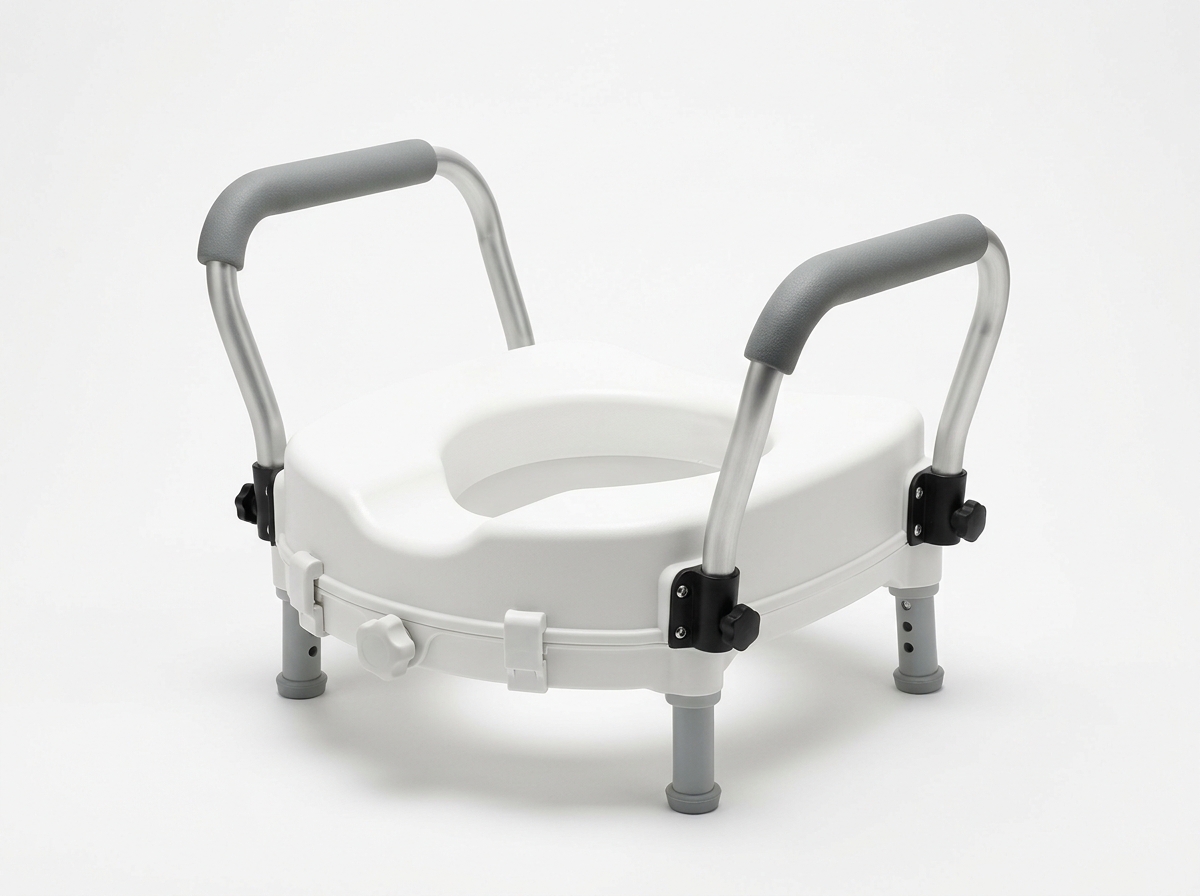
Raised toilet seat
Carex E-Z Lock Raised Toilet Seat With Handles
The first thing to try when standing up is the hard part but balance is still reasonable.
- Added height
- 5 in, per the product listing
- Arms
- Fixed handles, so there is something to push up from rather than something to pull on
- Weight capacity
- Not stated in the listing. Check the label on your own unit and follow that manual.
- Fit check
- Both feet must still reach the floor when seated. NHS guidance is to not use the seat if they cannot.
Honest limitation: a raised seat clamps to the bowl, so it is only as sound as the toilet under it. If the bowl or the tank fittings are already loose, or the brackets slip when you push the seat sideways, this makes the transfer worse rather than better.
We earn a commission on this link. It does not change the price you pay, and it does not influence which equipment we cover.
A toilet safety frame is the next step: a stand alone frame with arms on both sides, which gives the two point support the Access Board research kept pointing to. A three in one commode does the same job and two others besides, which is why it is often the better buy.
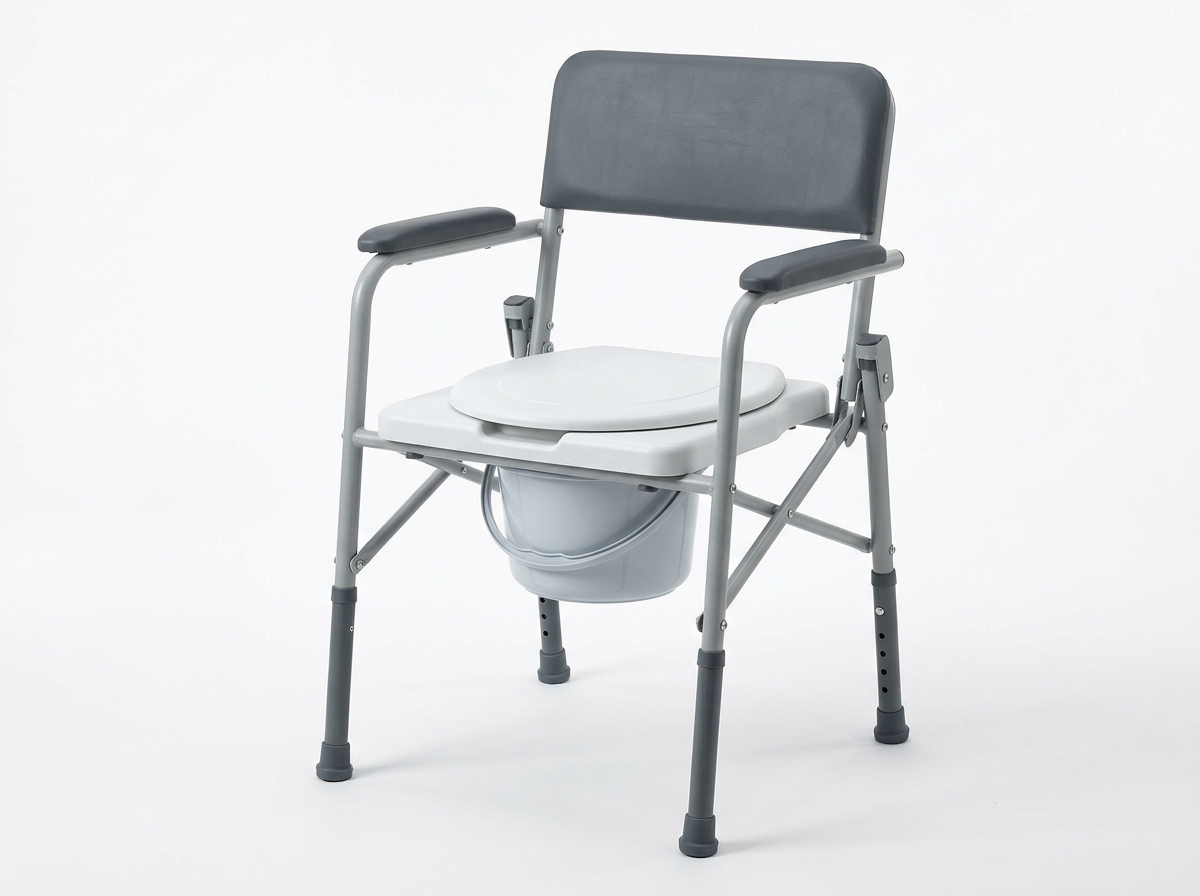
Three in one commode
Drive Medical Folding Steel Bedside Commode Chair
Bedside toilet, raised seat over the existing toilet, and safety frame, in one frame that folds.
- Weight capacity
- 350 lb, per the product listing. Confirm against the label on the unit you receive.
- Pail
- 7.5 qt, and it lifts out so the frame can sit over the toilet with the splash guard in place
- Leg height
- Adjustable. Set it so their feet rest flat and their knees are near 90 degrees.
- Three uses
- Beside the bed, over the toilet, or as a frame around the toilet
Honest limitation: a commode stands on the floor rather than fixing to the wall, so it can slide on wet tile if someone pulls sideways on an arm instead of pushing down. It also has to be emptied and cleaned, which is real daily work nobody mentions before you buy one.
We earn a commission on this link. It does not change the price you pay, and it does not influence which equipment we cover.
When a commode is the better answer than the toilet
Sometimes the transfer is not the problem. The trip is. If the bathroom door is too narrow for the wheelchair, if the walk down the hall is the part that exhausts them, or if the urgency at two in the morning means you will never get there in time, then a commode beside the bed is not a step down. It is the transfer that actually succeeds.
Some families use both. The commode sits over the toilet during the day, with the pail removed, so the room stays normal and the arms are there when they are needed. At night it moves beside the bed. Nothing has to be bought twice, and neither transfer becomes a fight.
When this stops working
These techniques work while the person can take weight through their legs, grip something, and move with your count. The ALS Network sets the threshold clearly: if they cannot help bear their own weight and you cannot safely lift them, the transfer needs a patient lift. A full body lift with a toileting sling does this job, and it is far easier to arrange before an injury than after one.
The step in between is a rolling shower and commode chair, which they sit in once and stay in for both the toilet and the shower. Our comparison of a shower chair against a transfer bench covers how that choice interacts with the tub.
Common questions
How much room do I actually need beside the toilet?
Enough to stand alongside without twisting. Access Board research on bathrooms built for assisted transfers found designers placing the toilet 22 to 30 inches from the side wall instead of the ADA figure of 18, most often 24 inches, specifically so a caregiver could get beside the fixture. If you have less, angle the chair in and accept a shorter, tighter turn.
Are suction grab bars safe to hold during a toilet transfer?
Not for weight. Drive Medical’s instructions for its suction cup bars say the bar “is to be used as a balance assist only” and “is not intended to support body weight”. If anything will be pulled or leaned on, fit a bar into studs or blocking. ADA rated bars have to hold 250 pounds of force at any point.
Should clothing come down before or after they stand?
Undo fastenings while they are still sitting, then lower the clothing once they are up and holding a bar with both hands. Doing all of it standing takes a hand off the support at the worst moment. Bars on both sides are what make this manageable, which is exactly what the Access Board research reported.
Raised seat or toilet frame first?
If the difficulty is only getting up off a low seat, start with height. If they wobble or reach for the sink on the way down, they need arms on both sides, which means a frame or a three in one commode. Many people end up with both. An occupational therapist can watch one transfer and tell you which in about a minute.