
Bathroom safety
How to Use a Shower Transfer Bench Safely
A shower transfer bench bridges the wall of a bathtub, two legs inside and two on the floor, so nobody steps over the wall. You sit on the outer end, turn to face the faucet, lift one leg at a time over the wall, then slide to the middle. Getting out is the same order reversed. All four legs must reach a floor and hold before anyone sits.
Show guidance for someone who
Before you start
- Bench is assembled to its own manual, with every spring button popped fully through its hole in the leg frame
- Weight rating on your bench’s own label is above the person’s weight. Do not assume it is generous
- Slip resistant mat or treads are down on the tub floor, which the Canadian Red Cross instructions call for with this bench
- Grab bar is within reach and screwed into the wall. ALS Network, a US nonprofit that provides ALS care services in California and Hawaii, warns that suction cup bars are unreliable
- Handheld shower hose is fitted, so the person never has to stand or twist to reach the water
- Towel, soap and clothing are inside arm’s reach before the water goes on
The procedure
Set the bench across the tub wall
Place two legs inside the tub, as close to the far wall as they will go, and two legs on the bathroom floor. The seat faces the faucet.
Both the Canadian Red Cross and the Townsville Hospital occupational therapy department put the rail on the inside end, against the wall. A bench installed the other way around gives you nothing to hold at the moment you need it most.
Adjust all four legs until the seat sits level
Press the spring button on each leg and slide it to length. Match the two inside legs to each other, match the two outside legs to each other, then look along the seat.
Most tub floors sit higher than the bathroom floor, so the inside pair almost always ends up shorter than the outside pair. Set all four the same and the seat tilts down toward the room, which is the direction the person is sliding.
Test the bench before anyone sits on it
Push down hard on the outer end, then on the inner end, and watch every foot. Nothing should lift, rock or slide.
The Red Cross instructions are explicit that all four legs must reach a floor and that the bench must not rest on the tub wall. A seat resting on the rim pivots on it as soon as weight lands on one end.
Tuck the curtain liner inside the tub
Bring the liner inside the tub wall and press it into the gap or slot on the inner part of the seat, so no part of it hangs over the outer legs.
A liner left hanging outside the bench runs water straight down the outer legs onto the tile, and that tile is what the person will stand up on afterward. Split curtains made for transfer benches solve this properly if tucking will not hold.
Sit down on the outer end
Back up until the person feels the seat against the backs of their legs, then lower them onto the outer end with both feet still on the bathroom floor.
Feeling the seat with the legs is what tells them where it is. Sitting down toward something they cannot see is how people miss the edge and land on the tub rim.
Turn to face the faucet
Pivot on the seat until they are square to the faucet, and slide back far enough that their calves rest against the tub wall.
The Red Cross instructions say to turn slowly and without twisting. Hips and shoulders move together as one piece. Twisting a spine on a wet plastic seat is where the caregiver gets hurt, not the person bathing.
Lift one leg at a time over the wall
Staying seated, lift the near leg over the tub wall and set the foot down, then the other. Lift the leg for them if they cannot, one at a time.
Nobody stands up to get their legs over. Standing inside a wet tub is the exact fall this bench exists to prevent, and the Townsville fact sheet says plainly that you do not need to stand up at any point.
Slide across to the middle of the seat
With one hand on the rail, have them slide across on their bottom until they are centered over the tub, then start the water.
Reverse the same order to get out
Slide back toward the tub wall, lift each leg out one at a time, then slide onto the outer end and dry off sitting down before standing.
Legs come out before the body moves out. Sliding the body out first leaves both feet trapped inside the tub with nothing under them.
Use caution
- Wet skin on a wet plastic seat slides in every direction, not only the one you want. Keep a hand on them the whole way across.
- Never steady anyone on a towel bar, a soap dish or a shower caddy. None of them are anchored to hold a person.
- Suction cup feet grip smooth surfaces only. On a textured or non slip tub floor they hold far less than they look like they do.
- The rail on the bench is a handhold for sliding, not a bar to haul yourself upright on.
- This page does not replace a session with an occupational therapist. Townsville’s OT department sets the seat height and watches the first transfer for a reason.
Stop and get help
- Any foot lifts, rocks or slides when you press down on either end of the seat
- The bench is resting on the tub wall instead of all four legs reaching a floor
- A spring button is not popped fully through its hole, or a leg slips under load
- They cannot stay upright on the seat without you holding them there
- The legs can no longer be lifted over the wall, even with you lifting them
Print the nine-step checklistOne page, large type, tape it inside the bathroom door.
Choosing a transfer bench
Measure across your tub from outer rim to outer rim before you buy anything, and measure the floor space outside it too. If you are still deciding between this and a seat that sits entirely inside the tub, we compare them on the shower chair versus transfer bench page. This one is the how-to.
For seat height, Townsville Hospital’s OT department suggests standing barefoot, measuring from the crease behind the knee down to the floor, and adding about two inches. Your own therapist’s number beats that estimate every time. Whatever height you land on, the seat still has to end up level across the wall.
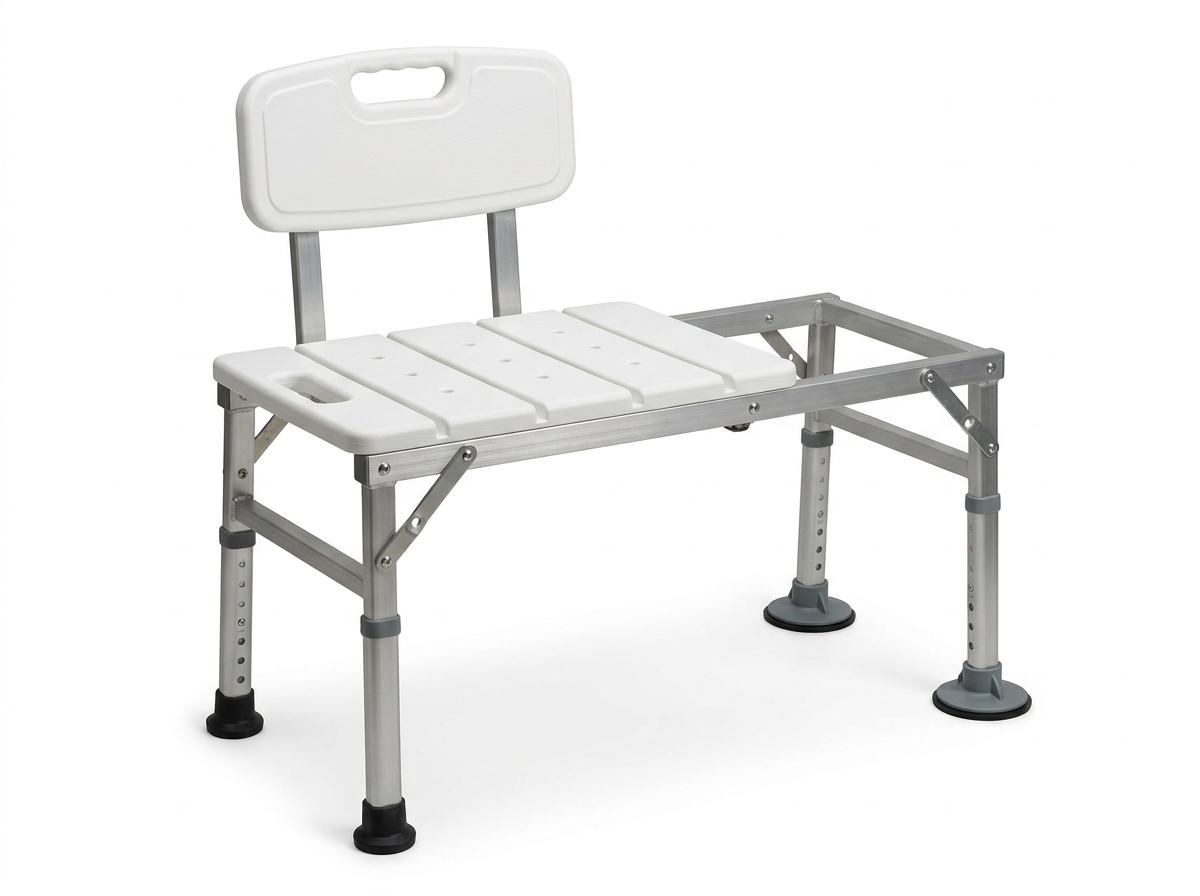
Bathroom safety
Tub transfer bench
The standard four-leg aluminum bench with a backrest, and the version most therapists set up in a home.
- Weight capacity
- 350 lb on this specific model. Ratings vary widely, so read the label on the bench you own.
- Typical price band
- $45 to $90
- Brands you will see
- Drive Medical, Medline, Vaunn
- Seat height
- Adjustable on all four legs. Set it from the knee measurement, then check the seat is level across the tub wall.
- Feet
- Rubber tips or suction cups. Suction only holds on a smooth tub floor, so put a slip resistant mat down either way.
Honest limitation: a transfer bench cannot be used with a tub that has glass shower doors. Memorial Sloan Kettering’s equipment guidance is to take the doors off and hang a curtain instead, which is a real change to the bathroom and not a small one. Check what is on your tub before you order.
We earn a commission on this link. It does not change the price you pay, and it does not influence which equipment we cover.
Keeping the water in the tub
This is the part nobody warns you about. The bench breaks the seal a shower curtain used to make, so water tracks along the seat and drips off the outer legs onto the floor. The CDC’s review of emergency department data found that most bathroom injuries are falls, and that bathing, showering and getting out of the tub account for the largest share of them.
Three things fix it, roughly in order of effort. Fit a handheld hose so water is aimed down instead of sprayed sideways. Tuck the liner into the gap on the inner part of the seat every single time. If that keeps pulling loose, buy a split curtain made for transfer benches, or a bench sold with a curtain guard built into the seat.
Dry the floor before anyone stands up on it, and put a mat down outside the tub as well as inside. The National Institute on Aging’s home fall guidance is to use non-skid mats or strips on every surface that gets wet, and grab bars both inside and outside the tub. More options are on our bathroom safety equipment page.
When this stops working
A bench works while the person can hold themselves upright sitting down and get their legs over with help. Once trunk control goes, or once lifting the legs over becomes a two-person job, the tub itself is the problem and not the technique.
Families living with ALS, MS or a spinal cord injury usually move next to a roll-in shower with a rolling shower commode chair, or to bed bathing. An occupational therapist can tell you which one your bathroom will take.
Common questions
Do they still have to step over the tub wall?
No. That is the entire point of the device. They sit down outside the tub and stay sitting the whole way in, lifting one leg at a time over the wall while seated. The Townsville Hospital OT fact sheet states that you do not need to stand up at any time while in the bath.
How do I stop water running onto the floor?
Tuck the curtain liner inside the tub and press it into the gap on the inner part of the seat, so nothing hangs over the outer legs. Add a handheld shower hose so the water is aimed downward. Split curtains and benches with a built-in curtain guard exist if tucking will not hold.
Does Medicare pay for a transfer bench?
Generally no. Original Medicare treats transfer benches, shower chairs and grab bars as convenience items rather than durable medical equipment. Some Medicare Advantage plans and some state Medicaid programs do cover them. Other routes are on our equipment funding page.
Can one caregiver do this alone?
Usually yes, if the person can sit steadily and help with the slide. The Canadian Red Cross recommends supervision or assistance for anyone with limited mobility, so have a second person for the first few attempts and keep a hand on them throughout.